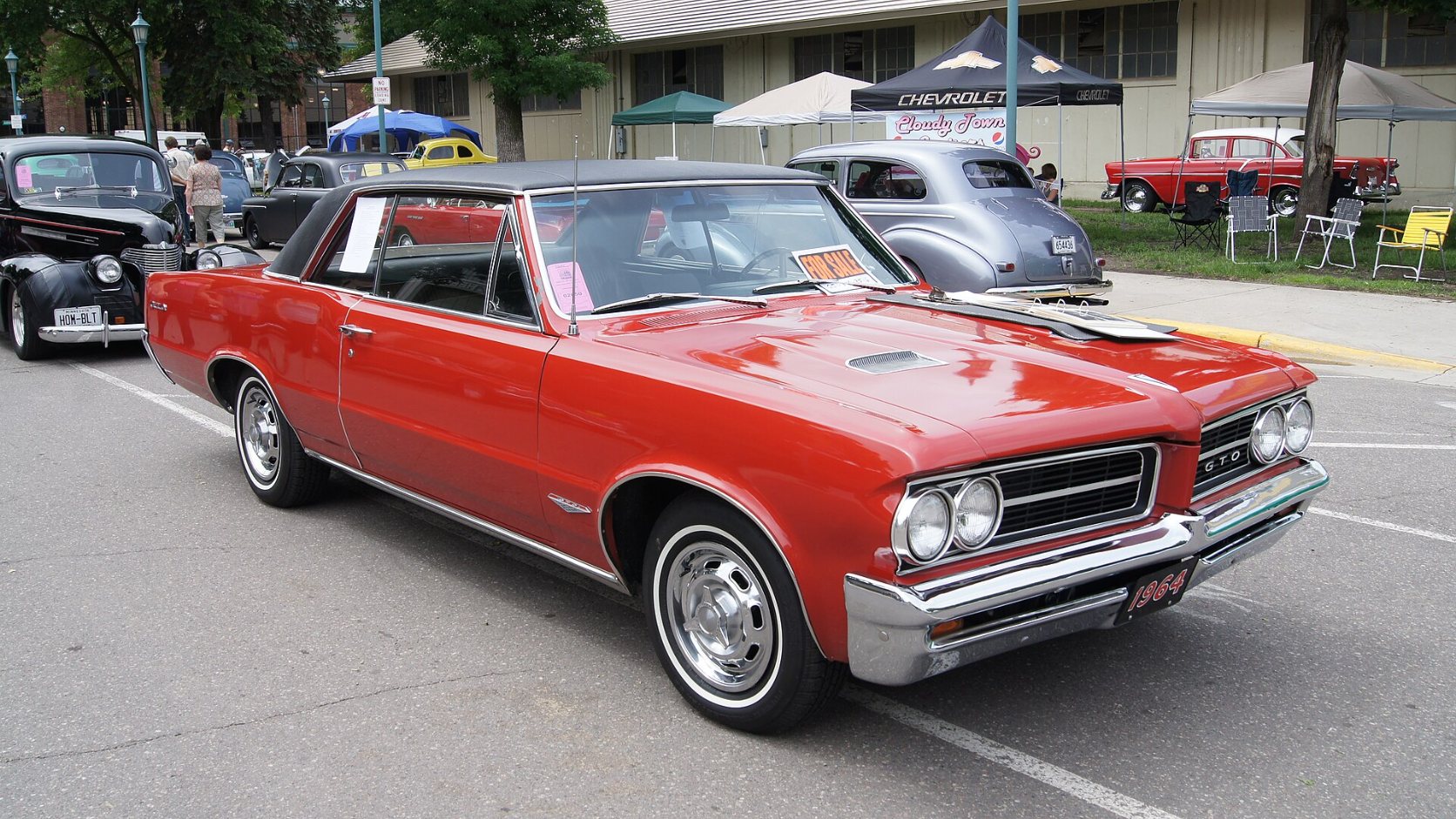
1964 Pontiac GTO
The 1964 Pontiac GTO put a 389 V8 in the mid-size LeMans and launched the muscle car era.
 1 / 6
1964 Pontiac GTO. Photo: Greg Gjerdingen from Willmar, USA via Wikimedia Commons, CC BY 2.0.
Overview
The 1964 Pontiac GTO is widely credited with starting the muscle car era. It was not a separate model at first but an option package for the mid-size Pontiac LeMans, created by a small team led by chief engineer John DeLorean with engineers Bill Collins and Russ Gee.
The idea was simple: put the 389 cubic-inch V8 from Pontiac’s full-size cars into the lighter A-body LeMans. General Motors had a rule limiting intermediates to 330 cubic inches, but because the GTO was sold as an option rather than a model, Pontiac was able to get it into showrooms.
For about $296, the GTO package included the 325-horsepower 389 V8, a floor-shifted three-speed manual, dual exhaust, stiffer suspension, hood scoops and GTO badges. The optional Tri-Power setup with three two-barrel carburetors raised output to 348 horsepower, and a four-speed manual was a popular choice.
Pontiac expected to sell about 5,000 cars. Instead it built 32,450, helped by advertising man Jim Wangers and a famous Car and Driver road test. The GTO’s success pushed rivals to respond and shaped the market that cars like the 1965 Ford Mustang and later big-block intermediates would compete in.
1964 GTO timeline
- 1962Earlier development
- 1963Previous model year
- 1964Featured model year
- 1965Continued evolution
Engine options
| Engine | Type | Horsepower | Torque | Fuel / induction | Notes |
|---|---|---|---|---|---|
| 389 four-barrel | V8 | 325 hp | 428 lb-ft | Single 4-barrel carburetor | Standard GTO engine |
| 389 Tri-Power | V8 | 348 hp | 428 lb-ft | Three 2-barrel carburetors | Optional |
Specifications at a glance
Production
- Hardtop18,422 (56.8%)
- Sports Coupe7,384 (22.8%)
- Convertible6,644 (20.5%)
Dimensions
Original colors
Color research in progress.
Performance
Buyer’s guide highlights
- Check the rear quarters, trunk floor, floor pans, lower fenders and rear window channel for rust.
- Verify a real GTO with PHS (Pontiac Historic Services) documentation, since 1964 VINs do not identify the GTO option.
- Check the engine block code and date for a correct 389.
- Confirm Tri-Power parts are original and not later additions.
- Inspect the frame, body mounts and suspension bushings.
- Buy on documentation; LeMans-based clones are common.
1. Check for Rust
Inspect any 1964 Pontiac GTO for rust in the rear quarter panels, trunk floor, floor pans, lower front fenders and around the rear window.
2. Document the Car
The 1964 VIN does not prove a car is a GTO. PHS documentation from the original factory records is the accepted way to confirm the GTO option, engine, transmission and color.
3. Check the Engine and Tri-Power
Look for a correctly coded 389 block and heads. Many four-barrel cars have had Tri-Power added later, which affects value.
4. Inspect the Chassis
Check the perimeter frame for rust and damage, and look at body mounts, bushings and brakes. The original drum brakes are weak by modern standards.
5. Buy the Best Example You Can
A documented, rust-free GTO costs more up front but is easier to own and holds its value better than a project car.
Values
1964 Pontiac GTO values are highest for documented Tri-Power four-speed convertibles and hardtops; four-barrel sports coupes are the most affordable, and undocumented cars sell at a clear discount.
Market references are research guides, not appraisals. Actual value depends on condition, originality, documentation, drivetrain, options, location and current buyer demand.