1965 Ford Mustang
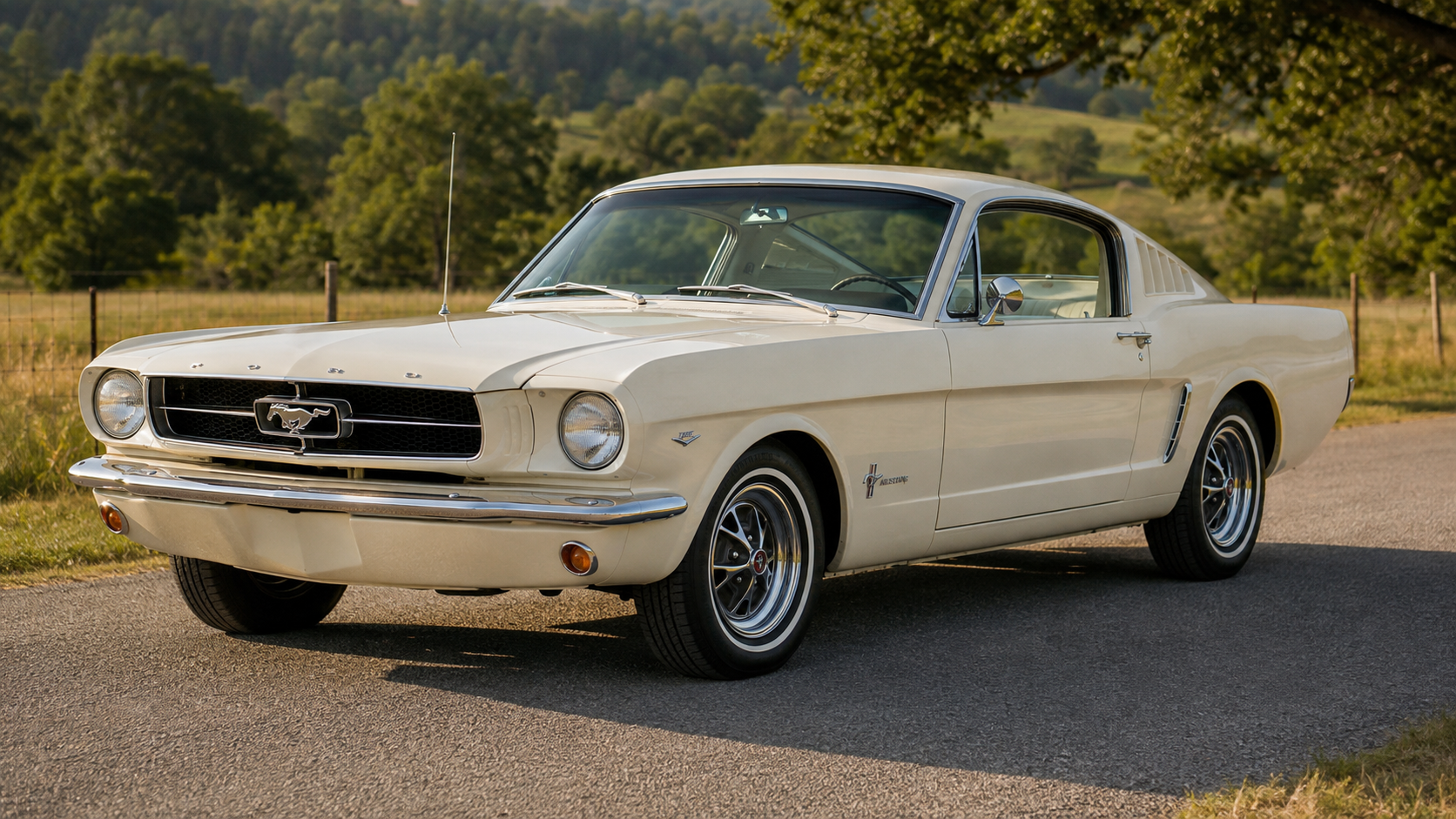
The 1965 Ford Mustang launched the pony car class with long-hood styling, compact dimensions, and a wide choice of six-cylinder and V8 engines.
 1 / 6
1 / 6
Overview
The 1965 Ford Mustang is the car that created an entire class of American automobile. Launched in April 1964 and built in greater numbers than any Mustang model year before or since, it combined long-hood, short-deck styling with compact dimensions, a low base price and an options list deep enough that almost no two cars left the factory identically equipped.
A launch that outran every forecast
Ford introduced the Mustang to the public on 17 April 1964, timed to coincide with the New York World’s Fair. The car was built on existing Falcon mechanical components, which kept development costs down and allowed Ford to price the hardtop at around $2,370 — within reach of buyers who would never have considered a European sports car.
Internal projections called for roughly 100,000 sales in the first year. Ford passed that figure within four months, committed two additional assembly plants to the car, and finished the extended 1965 model year at 680,989 units. It remains one of the most successful new-model launches in the history of the American motor industry.
Understanding the “1964½” cars
Because the Mustang went on sale roughly five months ahead of a conventional model year, the 1965 run is usually described in two phases. The 121,538 cars built between April and August 1964 are the ones collectors call “1964½” Mustangs. Every one of them left the factory as a hardtop or a convertible, and they used a generator-based charging system, a non-locking steering column and a number of other details that were revised for the regular model year.
The remaining 559,451 cars make up 1965 production proper. This later group brought the alternator, the 200-cubic-inch six, the 289 V8 in place of the 260, and the 2+2 fastback body style. Ford titled all of these cars as 1965 models, which is why the distinction matters far more to collectors than it does to the paperwork.
Body styles
Three bodies defined the range. The two-door hardtop coupe was the volume seller by a wide margin at 501,965 cars. The convertible, available from the first day of sales, accounted for 101,945. The 2+2 fastback arrived only with the regular model year and, with 77,079 built, had the shortest production window of the three — a large part of why it is the most sought-after of the standard bodies today.
Engines and performance
Buyers could choose from a genuinely wide spread of engines. Early cars came with a 170-cubic-inch inline-six or a 260-cubic-inch V8; the regular model year replaced these with a 200-cubic-inch six and the 289 V8 in two-barrel and four-barrel forms. At the top sat the K-code 289 High Performance V8, rated at 271 hp, with a solid-lifter valvetrain, larger carburettor and a dual-point distributor.
Output across the range therefore ran from 101 hp to 271 hp, and performance varied accordingly. A well-sorted V8 car will reach 60 mph in roughly seven and a half to eight and a half seconds, while six-cylinder examples are considerably more relaxed. Front disc brakes, the handling package and the GT Equipment Group were all extra-cost options rather than standard equipment.
What the 1965 Ford Mustang is like to own today
Few classic cars are easier to live with. Reproduction sheet metal, trim, interior components, glass and mechanical parts are manufactured in very large volume, and specialist suppliers cover almost every part of the car, which makes restoration costs unusually predictable. Club support is equally strong: the Mustang Club of America has run regional chapters and judging standards for the marque since 1976.
The main exceptions are early-production and low-volume parts. Some 1964½-specific components and K-code hardware are both scarce and expensive, so identifying exactly which specification a car is before you negotiate is worth real money. Our buyer’s guide below covers the inspection points that matter most.
Where the 1965 sits in the first-generation range
The 1965 car is the purest expression of the original design: compact, light and closely related to the Falcon underneath. Later cars grew. By the time of the 1967 Ford Mustang, Ford had widened and lengthened the body, made room for the big-block 390 FE V8 and pushed the Mustang further towards being a performance car than a stylish compact.
Both approaches have their followers, and neither is objectively better. If you want the car as it was originally conceived, the 1965 is the one. You can browse more Mustang model guides or see every Ford model in our database.
1965 Mustang timeline
- 1963Earlier development
- 1964Previous model year
- 1965Featured model year
- 1966Continued evolution
Engine options
| Engine | Type | Horsepower | Torque | Fuel / induction | Notes |
|---|---|---|---|---|---|
| 170 cu in (2.8L) | Inline-6 | 101 hp | 156 lb-ft | 1-barrel carburetor | Early-production 1965 base engine |
| 200 cu in (3.3L) | Inline-6 | 120 hp | 190 lb-ft | 1-barrel carburetor | Later 1965 base engine |
| 260 cu in (4.3L) | V8 | 164 hp | 258 lb-ft | 2-barrel carburetor | Early-production V8 |
| 289 cu in (4.7L) | V8 | 200 hp | 282 lb-ft | 2-barrel carburetor | Later 1965 entry-level V8 |
| 289 cu in (4.7L) | V8 | 225 hp | 305 lb-ft | 4-barrel carburetor | A-code performance V8 |
| 289 cu in (4.7L) Hi-Po | V8 | 271 hp | 312 lb-ft | 4-barrel carburetor | K-code high-performance V8 |
Specifications at a glance
Production
- Hardtop501,965 (73.7%)
- Convertible101,945 (15.0%)
- Fastback77,079 (11.3%)
Dimensions
Original colors
Performance
Buyer’s guide highlights
- Structural rust is the costliest problem to put right, so check the floor pans, torque boxes, cowl and shock towers first.
- Pour water through the cowl vents and watch the interior floor — cowl repair means removing the windshield and cutting into the structure.
- Confirm the VIN, engine and transmission numbers match the door data plate and any supporting paperwork.
- The K-Code 271 hp 289 is the most valuable engine option and the most often misrepresented, so verify the engine code in the VIN.
- Early-production "1964½" cars use a generator and a non-locking steering column, and some of their parts are harder to source.
- Fastbacks and convertibles command a premium over hardtops, and a solid documented car usually costs less than restoring a project.
1965 Ford Mustang Buyer's Guide
The 1965 Mustang is the first-year car and the most plentiful of all early Mustangs, which makes it one of the easiest classics to buy well. Hardtops, convertibles and 2+2 fastbacks are all readily available, and values swing widely on body style, engine, originality and the quality of any previous restoration. Because so many were built, there is rarely a reason to accept a rough car.
What to Check Before Buying
Rust: Corrosion is the single most expensive problem on an early Mustang and should be the first inspection point. Examine the floor pans, front and rear frame rails, torque boxes, rocker panels, lower doors, quarter panels, wheel arches, trunk floor, battery apron and the suspension mounting points. Structural rust can turn an apparently affordable car into a very expensive restoration.
Cowl leaks: The cowl vent area traps water and is a known weak point. Pour water through the exterior cowl vents and check for drips onto the interior floor. Cowl repair means removing the windshield and cutting into the structure, so it is a costly fault to discover after purchase.
Shock towers: Inspect the front shock towers and the surrounding inner aprons for cracking, rust and previous repair. Damage here affects front-end geometry and is a structural repair rather than a cosmetic one.
Engine and drivetrain: Confirm the engine starts easily, holds good oil pressure and does not smoke or make unusual noises. Check the transmission, differential, cooling system and driveline for leaks, vibration and wear. Original 260 V8s and 170 sixes are increasingly rare, as many were replaced with later 289 or 302 units.
Early-production details: Cars built before August 1964 use a generator rather than an alternator, a different charging system, a non-locking steering column and several unique trim and mechanical parts. Confirm which specification you are looking at, because these components are harder to source and are frequently mixed between cars.
Body condition: Check panel gaps, door alignment and the front structure for evidence of previous collision repair. Look for excessive filler, poorly repaired sheet metal and differences in paint finish between panels.
Brakes and suspension: Front drum brakes were standard and front discs were an option, so verify what the car actually has rather than assuming. Inspect steering components, bushings, ball joints and shocks. A car that wanders or pulls strongly under braking may need significant front-end work.
Verify the Car's Identity
Check the VIN and door data plate before purchasing, particularly on V8, GT and performance cars. The fifth character of the VIN is the engine code, and the K-code 271 hp High Performance 289 is the option most often misrepresented on this model year. Confirm the engine code, the assembly plant code and the scheduled build date against the car in front of you, and treat unverified claims about rare options as unverified.
The GT Equipment Group arrived partway through the model year, and genuine GT cars carry specific equipment rather than badges alone. Shelby GT350s are documented in their own registries and should never be authenticated on appearance.
Parts Availability
Parts support is exceptional. Reproduction sheet metal, trim, interior components, glass, weatherstrip and mechanical parts are manufactured in large volume, and specialist suppliers cover almost every part of the car. This makes restoration costs unusually predictable for a vehicle of this age. Early-production and low-volume items, including some 1964½-specific parts and K-code components, are the main exceptions and can be both scarce and expensive.
Which Version Should You Buy?
A six-cylinder or standard 289 V8 hardtop is the practical entry point and offers first-year ownership without the premium attached to rarer cars. Convertibles, 2+2 fastbacks, K-code 289 cars and documented GT and Shelby models command considerably stronger collector interest. Note that six-cylinder cars use lighter suspension and four-lug wheels, so converting one to V8 specification properly is a substantial job rather than a simple engine swap.
For most buyers a structurally solid, well-documented car is a better purchase than a cheaper example needing extensive rust repair. Restoration costs routinely exceed the price difference between a project and a good car.
Before You Purchase
Where possible, have the car inspected by a mechanic or restoration specialist who knows first-generation Mustangs. Verify the identification numbers, review any restoration records, service history and supporting documentation, and drive the car properly before committing.
Important
Market figures are research guides, not appraisals. A specific 1965 Mustang should be valued on its VIN, body style, drivetrain, factory options, originality, restoration quality, documentation, condition and current buyer demand.
Values
Values vary widely by body style, engine, originality and condition, so the reference points below matter more than any single figure.
| Variant / body style | Market reference | Reference value (USD) | Context |
|---|---|---|---|
| Coupe 260 V8 | Hagerty Price Guide | $20,400 | #3 Good condition benchmark |
| Coupe 289 V8 200 hp | Hagerty Price Guide | $22,500 | #3 Good condition benchmark |
| Coupe 289 V8 210 hp | Hagerty Price Guide | $24,600 | #3 Good condition benchmark |
| Convertible 289 V8 200 hp | Hagerty Price Guide | $30,100 | #3 Good condition benchmark |
| Fastback 289 V8 225 hp | Hagerty Price Guide | $49,300 | #3 Good condition benchmark |
| Coupe K-Code 289 Hi-Po | Hagerty Price Guide | $53,400 | #3 Good condition benchmark |
Market references are research guides, not appraisals. Actual value depends on condition, originality, documentation, drivetrain, options, location and current buyer demand.