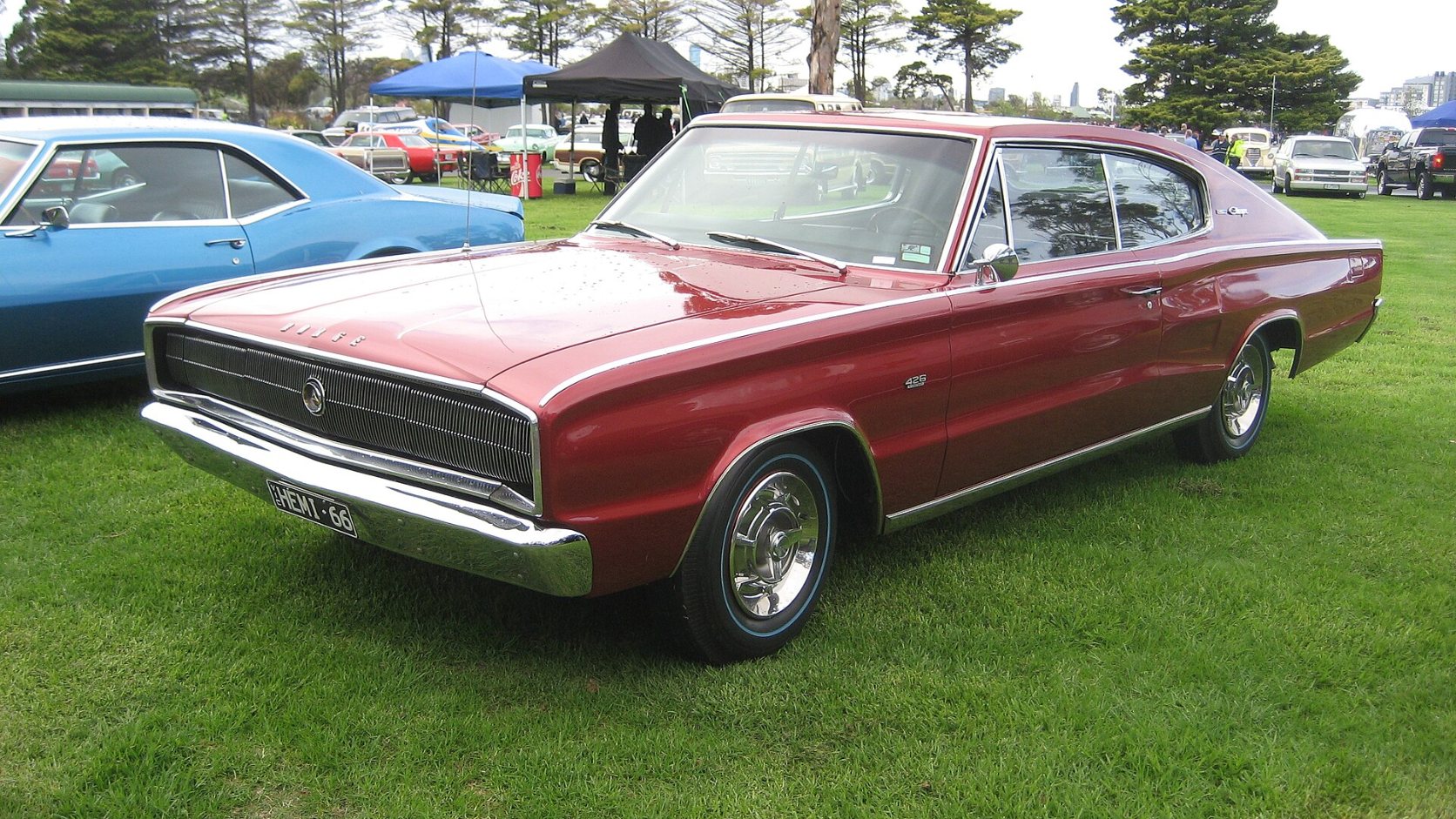
1966 Dodge Charger
The 1966 Dodge Charger debuted as a V8-only fastback with hidden headlights, four bucket seats and an optional 426 Hemi.
 1 / 6
1966 Dodge Charger. Photo: Sicnag via Wikimedia Commons, CC BY 2.0.
Overview
The 1966 Dodge Charger was the first production Charger, a mid-size fastback introduced at the start of 1966. It was based on the B-body Dodge Coronet and gave Dodge a sporty, upscale answer to cars like the Rambler Marlin and the fastback 1966 Ford Mustang.
The styling was the main attraction. The long sloping roofline ran all the way to the tail, the grille had hidden rotating headlights for a clean full-width look, and the rear carried a full-width taillight with CHARGER spelled across it.
The interior was just as unusual. Every Charger had four individual bucket seats, a full-length center console and electroluminescent gauges, and the rear seats folded flat to create a long cargo floor.
Engines were V8 only, starting with the 318 and moving up through the 361 and the 325-horsepower 383. At the top was the 426 Street Hemi, rated at 425 horsepower and installed in just 468 cars. Dodge built 37,344 Chargers for 1966, and the car also gave Dodge a strong shape for NASCAR, where David Pearson won the 1966 Grand National championship.
1966 Charger timeline
- 1964Earlier development
- 1965Previous model year
- 1966Featured model year
- 1967Continued evolution
Engine options
| Engine | Type | Horsepower | Torque | Fuel / induction | Notes |
|---|---|---|---|---|---|
| 318 | V8 | 230 hp | 340 lb-ft | 2-barrel carburetor | Base engine |
| 361 | V8 | 265 hp | 380 lb-ft | 2-barrel carburetor | Optional |
| 383 | V8 | 325 hp | 425 lb-ft | 4-barrel carburetor | Optional |
| 426 Street Hemi | V8 | 425 hp | 490 lb-ft | Dual 4-barrel carburetors | 468 built |
Specifications at a glance
Production
- 426 Hemi468 (1.3%)
- Other V8 engines36,876 (98.7%)
Dimensions
Original colors
Color research in progress.
Performance
Buyer’s guide highlights
- Check the rear quarters, trunk floor, floor pans, lower fenders and rear window area for rust.
- Test the hidden headlights, which rotate with electric motors and often fail.
- Check the electroluminescent gauges and the full-width taillight for correct operation.
- Inspect the unique interior, since consoles, seats and trim are hard to find.
- Verify a claimed 426 Hemi car with the VIN, fender tag and paperwork.
- Buy on completeness; first-generation trim parts are scarce.
1. Check for Rust
Inspect any 1966 Dodge Charger for rust in the rear quarter panels, trunk floor, floor pans, lower fenders and around the large rear window, where water can collect.
2. Test the Hidden Headlights and Electrics
The rotating headlights, electroluminescent gauges and full-width taillight are signature features. Make sure they all work, because repairs can be time-consuming.
3. Inspect the Interior
The four bucket seats, full-length console and folding rear seats are unique to the early Charger. Missing or damaged interior parts are difficult and costly to replace.
4. Verify Hemi Cars
Only 468 Hemi Chargers were built for 1966. Confirm the engine code in the VIN, the fender tag and any documentation before paying Hemi money.
5. Buy the Best Example You Can
Mechanical parts are shared with other B-body Dodges and are easy to find, but body and trim parts are not. A complete, solid car is the smart buy.
Values
1966 Dodge Charger values are led by documented 426 Hemi cars by a wide margin, followed by 383 four-speed cars; 318 and 361 Chargers remain among the more affordable 1960s Mopar fastbacks.
Market references are research guides, not appraisals. Actual value depends on condition, originality, documentation, drivetrain, options, location and current buyer demand.