1966 Ford Mustang
The 1966 Ford Mustang refined Ford’s original pony-car formula with subtle styling updates, strong sales and a broad choice of six-cylinder and 289 V8 engines.
 1 / 6
1 / 6
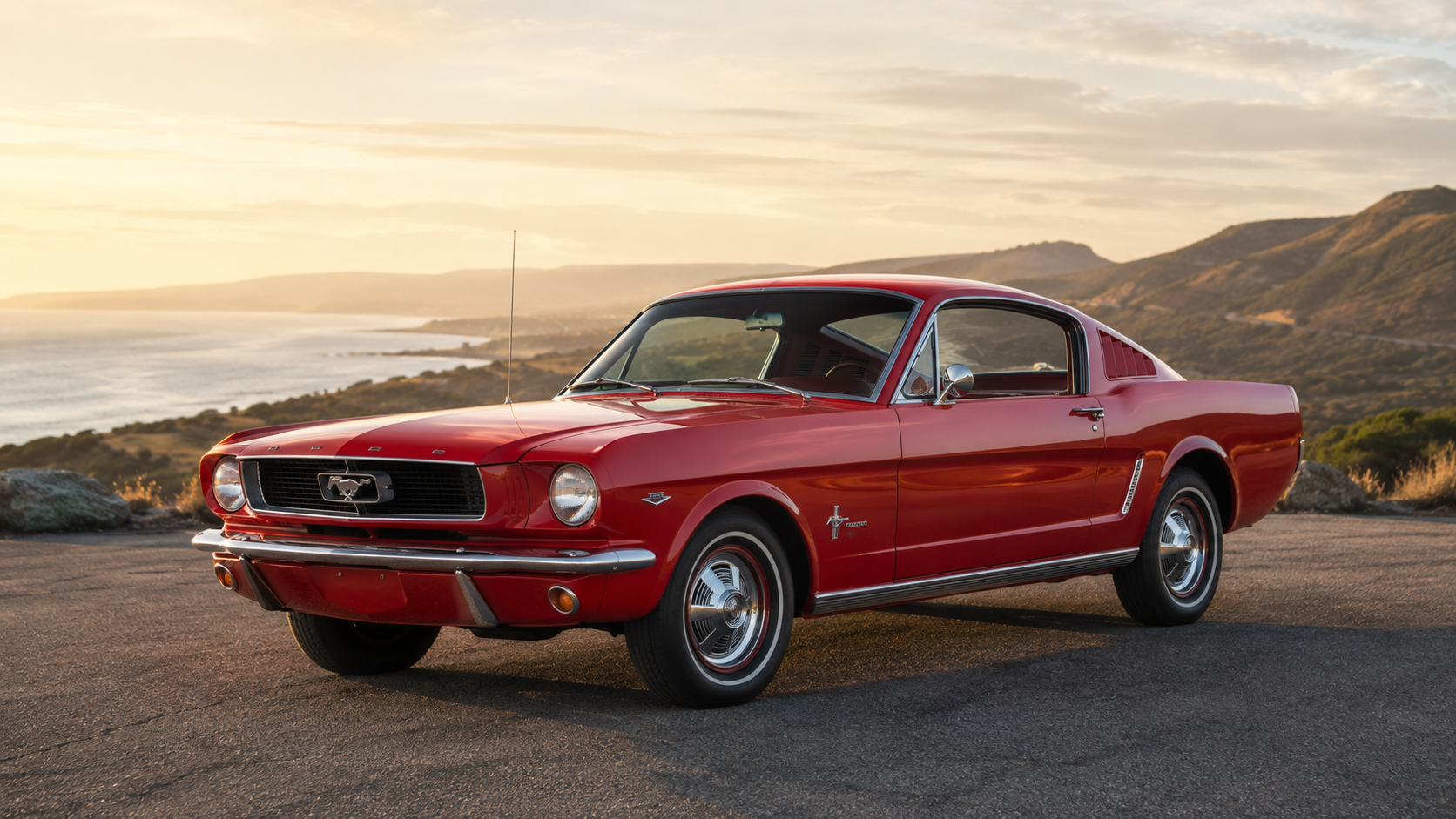
Restored 1966 Ford Mustang Fastback showing its classic first-generation Mustang styling.
Overview
The 1966 Ford Mustang refined the original pony-car formula at the moment of its greatest popularity. It kept the compact proportions and long-hood, short-deck profile that made the first Mustang an instant success, while adding enough visual and interior detail changes to make the model year easy to recognize. Ford built 607,568 examples, making 1966 the highest-volume conventional model year in first-generation Mustang production.
Peak year for the original Mustang shape
By the start of the 1966 model year, the Mustang was no longer an experiment. Demand remained extraordinary, three assembly plants were producing the car, and Ford had settled the range around a 200-cubic-inch inline-six and three versions of the 289-cubic-inch V8. The result was a more standardized lineup than the extended 1965 run, without the early-production generator systems or 170 and 260 engines that complicate the previous year.
The 1966 Ford Mustang was still based on compact Falcon mechanical architecture, but buyers could tailor it from an economical six-cylinder hardtop to a K-code fastback with the 271 hp High Performance 289. That breadth was central to the car’s success: it could be a stylish commuter, a comfortable convertible or a serious small-block performance car.
Styling changes for 1966
The basic body was carried over, but the detail changes are distinctive. The grille used a floating running-horse-and-corral emblem without the horizontal side bars seen on many 1965 cars. Revised side-scoop ornaments used horizontal accents, backup lamps became standard, and the fuel-filler emblem and wheel covers were updated.
Inside, the most important change was the five-round-gauge instrument cluster. The circular speedometer, fuel, temperature, oil-pressure and charging gauges gave every 1966 dashboard the sporting layout that had previously been associated with the GT package. Buyers could also choose the Interior Décor Group — commonly called the Pony interior — with embossed running-horse seat panels, upgraded door trim and bright details.
Body styles and production
Ford offered the same three bodies as the regular 1965 range. The notchback hardtop remained the overwhelming volume seller at 499,751 units. Convertible production reached 72,119, while the 2+2 fastback accounted for 35,698. Together they total 607,568 cars.
The hardtop is therefore the easiest and usually the least expensive version to buy. Convertibles carry a premium for open-air appeal, while fastbacks are scarcer and attract the strongest demand among standard 1966 Mustangs. Factory GT equipment, documented K-code power and original high-quality specifications add further value.
Engines and performance
The base engine was the 200 cu in (3.3L) inline-six with a one-barrel carburetor, rated at 120 hp and 190 lb-ft of torque. The entry V8 was the C-code 289 with a two-barrel carburetor, producing 200 hp and 282 lb-ft. Above it sat the A-code four-barrel 289 at 225 hp and 305 lb-ft.
The rare K-code High Performance 289 was the most serious factory engine. Rated at 271 hp and 312 lb-ft, it used a solid-lifter camshaft, higher compression, a larger carburetor, stronger internal components and other durability upgrades. Performance depends on axle ratio, transmission, body style and condition, but a healthy V8 car typically reaches 60 mph in roughly 7.5 to 8.5 seconds; six-cylinder cars are appreciably more relaxed.
Transmissions, brakes and chassis
Transmission choices included three- and four-speed manuals and the three-speed Cruise-O-Matic automatic. Drum brakes were standard, with front discs available as an option. The GT Equipment Group combined front disc brakes, quicker steering, heavy-duty suspension, fog lamps, dual exhaust and distinctive trim, although equipment should always be verified rather than authenticated by badges alone.
Six-cylinder cars used lighter-duty suspension and four-lug wheels, while V8 cars received five-lug hubs and stronger supporting hardware. A proper six-to-V8 conversion therefore involves far more than changing the engine. For buyers who value originality, the VIN and door data plate are essential: engine codes T, C, A and K identify the factory powerplant, and body codes distinguish the hardtop, convertible and fastback.
Options and special versions
Popular options included power steering, power brakes, air conditioning, a center console, styled steel wheels, Rally-Pac instruments, radios and several axle ratios. The 1966 Shelby GT350 and Hertz GT350H were high-performance derivatives built by Shelby American and are separate, highly documented collector models rather than ordinary Mustangs with cosmetic additions.
Original factory literature and period documentation are available through the Ford Heritage Vault. Comparing a car’s codes and equipment with period information is especially important when evaluating claims about GT, K-code or rare-option status.
What the 1966 Ford Mustang is like to own today
Parts support is exceptional. Reproduction sheet metal, glass, interior trim, suspension components, brakes and drivetrain parts are widely available, and almost every common repair is well documented. That makes the 1966 model one of the most approachable American classics to maintain and restore.
Rust remains the decisive issue. Floor pans, torque boxes, frame rails, cowl vents, shock towers, rocker panels, lower quarters and trunk drop-offs can all corrode. Structural repairs quickly cost more than the price difference between a project and a sound car, so body condition and documentation should carry more weight than fresh paint.
Where the 1966 fits in Mustang history
The 1965 Ford Mustang is the launch-year original, complete with the early-production “1964½” story. The 1966 is the polished, peak-volume version of the same compact body. For 1967, Ford enlarged the car and created space for big-block power; our 1967 Ford Mustang guide covers that major redesign.
For buyers who want the clean proportions of the earliest Mustang with a simpler and more consistent specification than 1965, the 1966 is a compelling choice. You can browse every Mustang model guide, explore more classic Fords, or return to the complete car database.
Engine options
| Engine | Type | Horsepower | Torque | Fuel / induction | Notes |
|---|---|---|---|---|---|
| 200 cu in (3.3L) | Inline-6 | 120 hp | 190 lb-ft | 1-barrel carburetor | Standard six-cylinder engine |
| 289 cu in (4.7L) | V8 | 200 hp | 282 lb-ft | 2-barrel carburetor | C-Code V8 |
| 289 cu in (4.7L) | V8 | 225 hp | 305 lb-ft | 4-barrel carburetor | A-Code high-compression V8 |
| 289 cu in (4.7L) Hi-Po | V8 | 271 hp | 312 lb-ft | 4-barrel carburetor | K-Code high-performance V8 |
Specifications at a glance
Production
- Hardtop499,751 (82.3%)
- Convertible72,119 (11.9%)
- Fastback35,698 (5.9%)
Dimensions
Original colors
Performance
Buyer’s guide highlights
- ✓ Structural rust is the biggest concern — inspect the floor pans, frame rails, torque boxes, cowl and shock towers carefully.
- ✓ Check the cowl for water leaks; cowl corrosion can require extensive disassembly and expensive structural repair.
- ✓ Verify the VIN, door data plate, engine and transmission details, especially on valuable A-Code and K-Code cars.
- ✓ The 271-hp K-Code 289 is the most collectible factory engine option, so authentication is especially important.
- ✓ Inspect steering, suspension, brakes and drivetrain condition; decades of modifications are common on early Mustangs.
- ✓ Fastbacks and convertibles generally command higher prices than hardtops, making originality and documentation more important.
1966 Ford Mustang Buyer’s Guide
1. Check Carefully for Structural Rust
Rust is one of the most important things to inspect when buying a 1966 Ford Mustang because structural repairs can quickly become expensive. Pay particular attention to the floor pans, front frame rails, torque boxes, rocker panels, rear quarter panels and shock towers. Surface rust is usually manageable, but corrosion affecting structural areas can require extensive cutting and welding.
Inspect the underside rather than judging the car only by its exterior paint. A Mustang with attractive paint can still hide previous rust repairs, filler or poorly installed replacement panels.
2. Inspect the Cowl for Water Leaks
The cowl area is a well-known trouble spot on early Mustangs. Leaves and moisture can collect around the cowl vents and eventually cause corrosion around the internal metal structure.
A useful inspection method is to carefully pour water through the exterior cowl vents and check whether water enters the front footwells. Damp carpet, staining or visible corrosion deserves further investigation. Repairing a badly rusted cowl can be labor-intensive because access may require removal of the windshield and surrounding bodywork.
3. Verify the VIN, Engine and Transmission
Before paying a premium for a particular specification, confirm what the Mustang actually is. Check the VIN and door data plate and compare the information with the engine, transmission, body style, paint and trim presented by the seller.
Documentation such as previous registrations, restoration records, invoices and ownership history can strengthen a car's provenance. This becomes particularly important with valuable configurations because engines, transmissions and other components may have been replaced during the car's lifetime.
4. Authenticate K-Code and High-Performance Cars
The 271-horsepower 289 Hi-Po, commonly associated with the K-Code Mustang, is among the most desirable 1966 engine configurations. That desirability also means buyers should be especially careful when evaluating cars advertised as genuine K-Code examples.
Do not rely solely on badges, valve covers or other easily changed components. Verify the VIN and relevant identification details and look for supporting documentation. A genuine, documented high-performance Mustang can command a substantial premium over a standard V8 car.
5. Consider Parts Availability and Model-Year Details
The 1966 Mustang benefits from excellent parts availability compared with many other cars of its era. Mechanical components, interior pieces, trim and reproduction body panels are widely available, making restoration and regular ownership relatively practical.
However, originality still matters. Before purchasing an expensive or highly original example, check whether important components are correct for the model year. Replacing missing reproduction parts may be straightforward, while locating certain correct original or date-appropriate components can be considerably more difficult and expensive.
6. Buy the Best Body Style and Condition You Can Afford
Hardtop coupes are generally the most plentiful 1966 Mustangs and can provide an accessible entry into classic Mustang ownership. Fastbacks and convertibles are typically more desirable in the collector market and often command higher prices, especially when combined with desirable factory V8 specifications.
Condition should still come before body style. A documented, structurally sound hardtop can be a much better purchase than a cheap fastback requiring major rust repair. Compare restoration quality, originality, mechanical condition and documentation—not simply the asking price—before deciding which 1966 Ford Mustang offers the best value.
Values
1966 Ford Mustang values vary widely by body style, engine, originality and condition, with fastbacks, GT models and documented K-Code cars generally commanding the strongest premiums.
| Variant / body style | Market reference | Reference value (USD) | Context |
|---|---|---|---|
| Convertible 289 V8 200 hp | Hagerty Price Guide | $26,900 | #3 Good condition benchmark, 289 cu in / 200 hp 2-barrel |
| Convertible 289 V8 225 hp | Hagerty Price Guide | $31,100 | #3 Good condition benchmark, 289 cu in / 225 hp 4-barrel |
| Fastback 289 V8 225 hp | Hagerty Price Guide | $51,400 | #3 Good condition benchmark, 289 cu in / 225 hp 4-barrel |
| Fastback K-Code 289 Hi-Po | Hagerty Price Guide | $71,400 | #3 Good condition benchmark, 289 cu in / 271 hp Hi-Po |
| GT Fastback 289 V8 | Auction result, Jul 2026 | $75,600 | Reported sold price, 225 hp GT fastback |
Market references are research guides, not appraisals. Actual value depends on condition, originality, documentation, drivetrain, options, location and current buyer demand.