1972 Ford Mustang
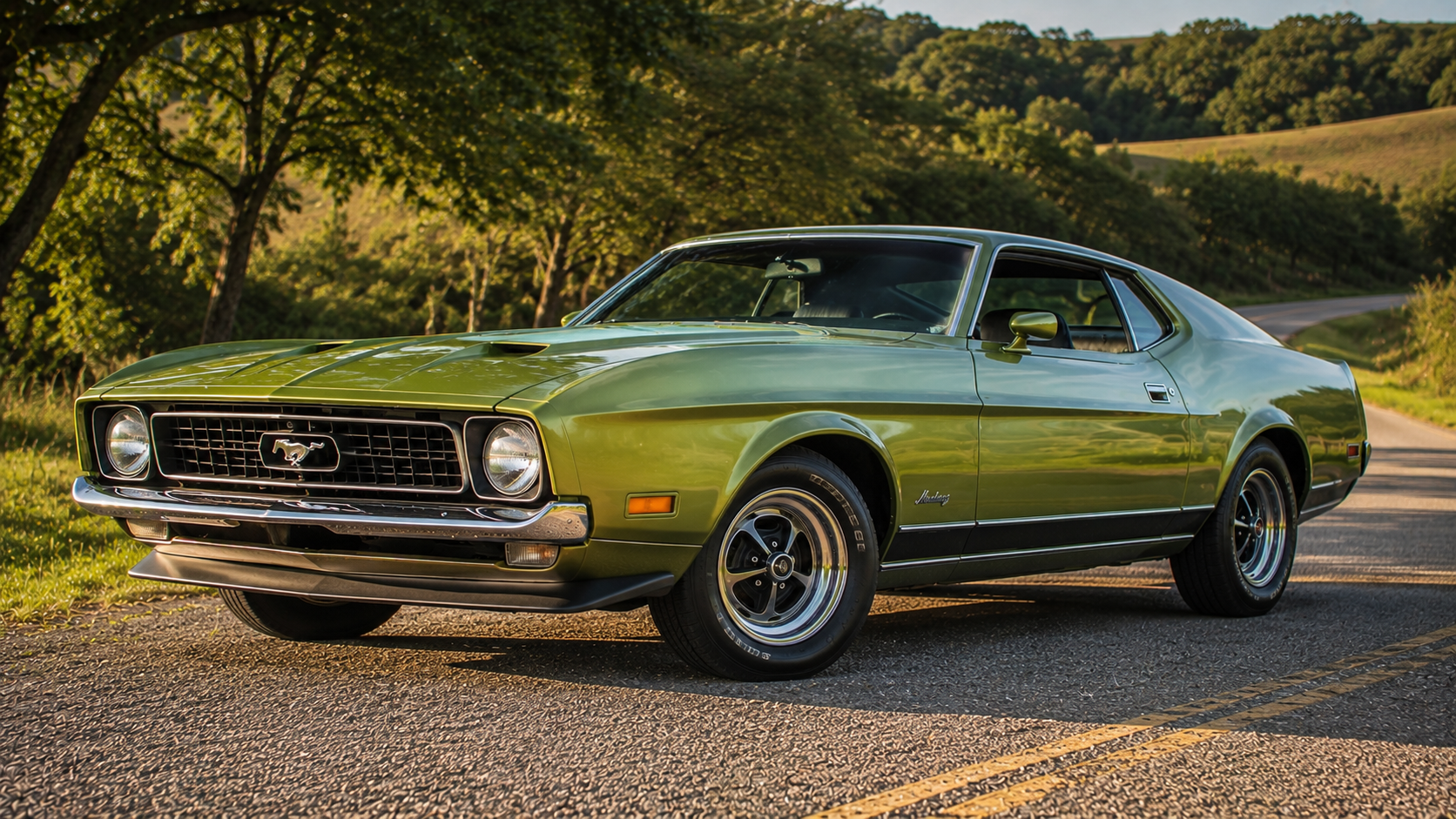
The 1972 Ford Mustang retained the larger 1971 body while adopting SAE net horsepower ratings and a streamlined engine lineup centered on the 250 six, 302 V8 and 351 Cleveland.
 1 / 6
Overview
The 1972 Ford Mustang carried forward the larger body introduced the previous year, but its mechanical story reflected major changes taking place throughout the American automobile industry. Compared with the 1971 Ford Mustang, exterior styling changed only subtly, while lower compression ratios, tightening emissions requirements and a new SAE net horsepower rating system reshaped the engine lineup.
Ford continued to offer the Mustang as a hardtop coupe, SportsRoof and convertible, along with the luxury-oriented Grande and performance-styled Mach 1. The basic body remained imposing, with a 109-inch wheelbase, broad stance and the distinctive low-roof SportsRoof profile introduced for 1971. A patriotic Sprint package was also offered during 1972 with red, white and blue exterior and interior details.
The biggest changes were under the hood. The 429 big-block engines and one-year-only Boss 351 disappeared, leaving the 250-cubic-inch inline-six, 302 V8 and several versions of the 351 Cleveland. The strongest regular performance option was the Q-code 351 Cobra Jet, while a relatively rare R-code 351 High Output engine sat at the top of the range with 275 SAE net horsepower.
The apparently dramatic horsepower decline compared with the 1970 Ford Mustang does not represent a simple one-for-one loss of engine output. By 1972, advertised horsepower was measured using the more realistic SAE net method with the engine in installed form, rather than the older gross rating system. Lower compression ratios and emissions tuning also reduced actual performance, but the change in measurement method makes direct numerical comparisons with earlier Mustangs misleading.
Today, the 1972 Ford Mustang represents one of the final chapters of the original 1965–1973 generation. Standard coupes and SportsRoofs remain relatively attainable, while Mach 1 models, documented Sprint cars, Q-code Cobra Jets and rare R-code 351 H.O. examples receive stronger collector interest. Current configuration-specific collector values can be researched through the Hagerty 1972 Ford Mustang guide.
1972 Mustang timeline
- 1970Earlier development
- 1971Previous model year
- 1972Featured model year
- 1973Continued evolution
Engine options
| Engine | Type | Horsepower | Torque | Fuel / induction | Notes |
|---|---|---|---|---|---|
| 250 cu in (4.1L) | Inline-6 | 95 hp | 197 lb-ft | 1-barrel carburetor | L-Code standard engine; SAE net rating |
| 302 cu in (4.9L) Windsor | V8 | 140 hp | 239 lb-ft | 2-barrel carburetor | F-Code small-block V8; SAE net rating |
| 351 cu in (5.8L) Cleveland | V8 | 177 hp | 284 lb-ft | 2-barrel carburetor | H-Code 351 Cleveland 2V; SAE net rating |
| 351 cu in (5.8L) Cobra Jet | V8 | 266 hp | 301 lb-ft | 4-barrel carburetor | Q-Code 351 Cleveland Cobra Jet; SAE net rating |
| 351 cu in (5.8L) High Output | V8 | 275 hp | 286 lb-ft | 4-barrel carburetor | R-Code 351 H.O.; rare high-performance engine with SAE net rating |
Specifications at a glance
Production
- Hardtop75,395 (60.3%)
- SportsRoof43,297 (34.6%)
- Convertible6,401 (5.1%)
Dimensions
Original colors
Performance
Buyer’s guide highlights
- Inspect the floor pans, frame rails, torque boxes, shock towers, trunk floor and cowl carefully for structural rust and previous repairs.
- Check the cowl and front footwells for water intrusion, and examine the large body panels for concealed corrosion or poor collision repairs.
- Verify the VIN, data plate, engine and transmission carefully, especially on Mach 1, Q-code Cobra Jet and rare R-code 351 H.O. cars.
- Understand the 1972 SAE net horsepower ratings and avoid judging engine authenticity or performance using earlier gross-horsepower figures.
- Inspect steering, suspension, brakes, wiring and restoration workmanship carefully because the larger 1971–1973 Mustang is a relatively heavy car.
- Buy primarily on structural condition, authenticity and documentation; genuine Mach 1, Sprint, Cobra Jet and 351 H.O. examples deserve additional verification.
1. Inspect Carefully for Structural Rust
Structural condition should be the first priority when evaluating a 1972 Ford Mustang. Inspect the floor pans, front and rear frame rails, torque boxes, rocker areas, shock towers, trunk floor and rear quarter structure carefully. These cars use substantial amounts of sheet metal, and repairing widespread structural corrosion can quickly exceed the cost of buying a better example.
Examine the underside for overlapping patches, crude welds, excessive seam sealer and recently applied undercoating. Fresh paint underneath a car is not necessarily evidence of a good restoration, so determine what lies beneath it whenever possible.
2. Check the Cowl and Previous Body Repairs
Cowl corrosion remains an important first-generation Mustang problem. Debris and trapped moisture can attack hidden sections of the cowl structure and eventually allow water to enter the front passenger compartment.
Check the carpets, firewall and front floors for dampness, staining and previous repairs. Also examine the long hood, broad quarter panels and large SportsRoof body carefully for filler, poor panel alignment and evidence of previous collision damage.
3. Verify the VIN, Data Plate and Drivetrain
Correct identification becomes increasingly important on valuable 1972 Mustangs. Decode the VIN and certification label and verify the body style, engine code, transmission, original color and other available information against the vehicle being advertised.
This is particularly important with Mach 1 and high-performance cars. An F-code 302, H-code 351, Q-code Cobra Jet and rare R-code 351 H.O. represent substantially different specifications and collector values. Documentation, restoration records and ownership history can help establish exactly what a car is.
4. Understand the 1972 Horsepower Ratings
The 1972 model year can cause confusion because Ford was now advertising horsepower using SAE net ratings. Earlier gross ratings were measured under more favorable laboratory conditions, while net ratings more closely represented an engine as installed in the vehicle with accessories and normal intake and exhaust equipment.
As a result, the 95-horsepower six-cylinder and 140-horsepower 302 should not be compared numerically with earlier gross-rated engines without understanding the measurement change. When verifying a 1972 car, use year-specific specifications rather than assuming an earlier Mustang's horsepower figure applies.
5. Evaluate Steering, Suspension, Brakes and Restoration Quality
The 1971–1973 Mustang is larger and heavier than the earliest first-generation cars, making the condition of its steering, suspension and brakes particularly important. During a road test, watch for excessive steering play, wandering, vibration, suspension noise and uneven braking.
Many surviving cars have also received replacement engines, aftermarket wheels, ignition upgrades or other modifications. Modifications are not necessarily undesirable, but workmanship matters. Check wiring, welding, brake work, suspension installation and panel alignment carefully.
6. Buy Condition, Authenticity and Documentation First
Standard coupes generally provide the most affordable route into 1972 Mustang ownership, while SportsRoofs and Mach 1s tend to attract greater collector interest. Sprint-package cars provide another distinctive 1972 variation, and genuine Q-code Cobra Jet and R-code 351 H.O. cars deserve especially careful authentication.
A rare specification does not compensate for serious structural problems or questionable identity. A solid, accurately represented and well-documented Mustang will usually make a better long-term purchase than a supposedly rare example requiring major corrective work.
Values
1972 Ford Mustang values vary considerably by body style and drivetrain, with standard coupes remaining accessible while SportsRoofs, Mach 1s and genuine Cobra Jet or 351 H.O. cars command stronger collector interest.
| Variant / body style | Market reference | Reference value (USD) | Context |
|---|---|---|---|
| Hardtop 302 V8 | Hagerty Price Guide | $11,900 | #3 Good condition benchmark, 302 cu in / 140 hp 2-barrel |
| SportsRoof 302 V8 | Hagerty Price Guide | $15,700 | #3 Good condition benchmark, 302 cu in / 140 hp 2-barrel |
| Convertible 302 V8 | Hagerty Price Guide | $19,600 | #3 Good condition benchmark, 302 cu in / 140 hp 2-barrel |
| SportsRoof 351 V8 2V | Hagerty Price Guide | $18,800 | #3 Good condition benchmark, 351 cu in / 177 hp 2-barrel |
| SportsRoof 351 Cobra Jet | Hagerty Price Guide | $26,600 | #3 Good condition benchmark, 351 cu in / 266 hp Cobra Jet |
| Convertible 351 H.O. | Hagerty Price Guide | $20,500 | #3 Good condition benchmark, 351 cu in / 275 hp High Output |
Market references are research guides, not appraisals. Actual value depends on condition, originality, documentation, drivetrain, options, location and current buyer demand.