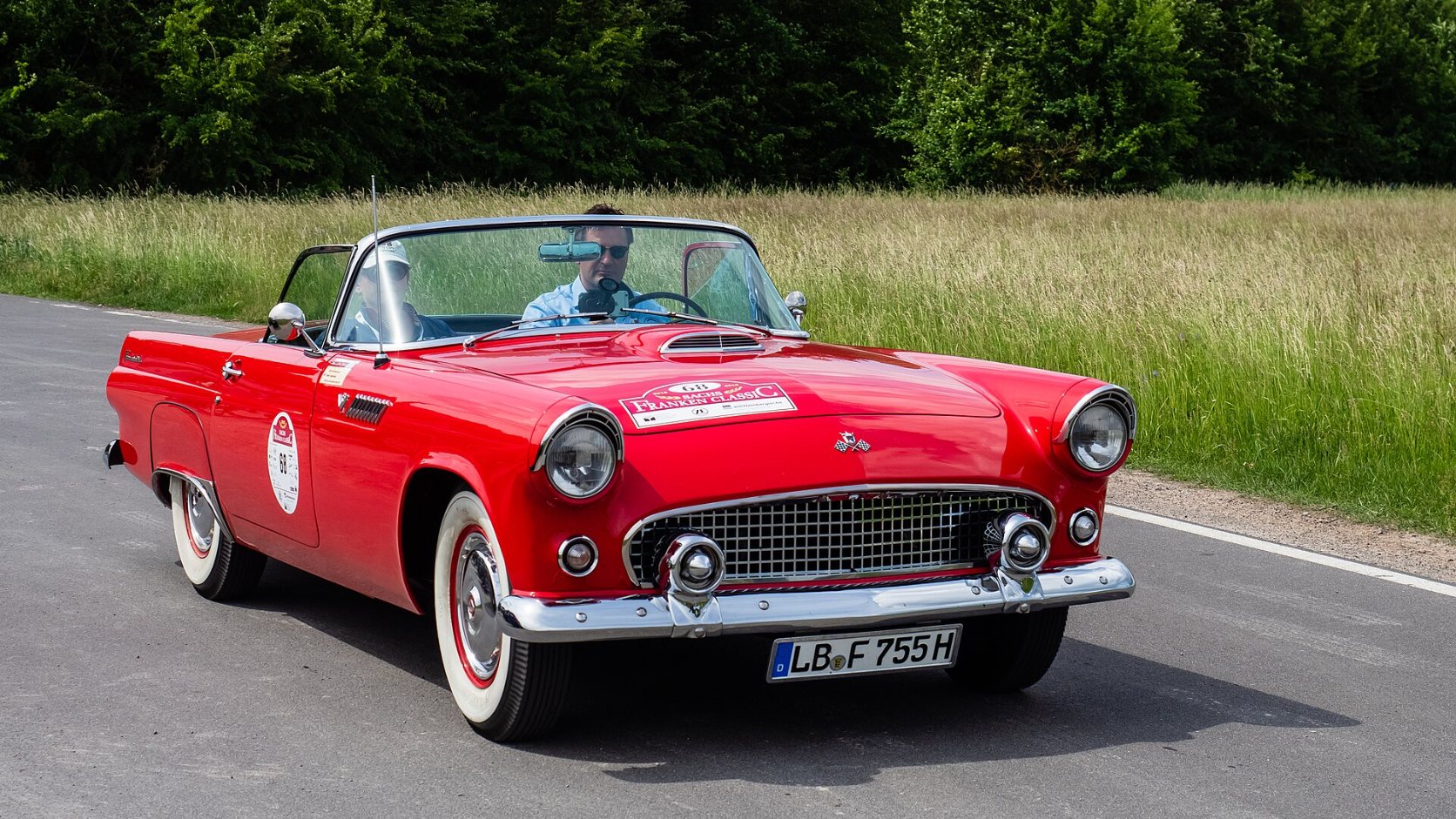
1955 Ford Thunderbird
The 1955 Ford Thunderbird launched the T-Bird as a V8-powered two-seat personal car that far outsold the Corvette.
 1 / 6
1955 Ford Thunderbird. Photo: Ermell via Wikimedia Commons, CC BY-SA 4.0.
Overview
The 1955 Ford Thunderbird was the first Thunderbird, a two-seat convertible that went on sale in October 1954. It was Ford’s answer to the Chevrolet Corvette, but Ford marketed it as a “personal car” that mixed sporty looks with comfort rather than as a pure sports car.
That approach worked. The Thunderbird came with a V8 as standard, roll-up windows, and a choice of a removable fiberglass hardtop or a folding fabric top, at a time when the Corvette was still a more basic machine. Power seats, power windows and power steering were on the options list.
Every 1955 Thunderbird used the 292 cubic-inch Y-block V8, rated at 193 horsepower with the three-speed manual and 198 horsepower with the Ford-O-Matic automatic. Styling was clean and low, with a hood scoop, hooded headlights and small tailfins tied to the look of the full-size 1955 Fords.
Ford planned for about 10,000 cars and built 16,155, far outselling the Corvette that year. The two-seat Thunderbird lasted only through 1957, but it started a nameplate that ran for decades and showed Ford the value of a stylish personal car, an idea that returned in a different form with the 1965 Ford Mustang.
1955 Thunderbird timeline
- 1953Earlier development
- 1954Previous model year
- 1955Featured model year
- 1956Continued evolution
Engine options
| Engine | Type | Horsepower | Torque | Fuel / induction | Notes |
|---|---|---|---|---|---|
| 292 Y-block (manual) | V8 | 193 hp | Approx. 280 lb-ft | 4-barrel carburetor | With 3-speed manual or overdrive |
| 292 Y-block (automatic) | V8 | 198 hp | Approx. 286 lb-ft | 4-barrel carburetor | With Ford-O-Matic |
Specifications at a glance
Production
16,1551955 Ford Thunderbird
Dimensions
Original colors
Color research in progress.
Performance
Buyer’s guide highlights
- Check the floors, rocker panels, lower fenders, door bottoms and trunk floor for rust.
- Inspect the frame, especially around the rear spring mounts.
- Check whether the car has its removable hardtop, fabric top or both, since that affects value.
- Look for a correct 292 Y-block and original 6-volt electrical parts, or a well-done 12-volt conversion.
- Check power options, the telescoping steering column and gauges for correct operation.
- Buy on rust-free structure and completeness; trim and tops are costly.
1. Check for Rust
Inspect any 1955 Ford Thunderbird for rust in the floors, inner and outer rocker panels, lower front fenders, door bottoms and trunk floor. Repairs here are labor-intensive.
2. Inspect the Frame
Look at the frame rails and rear spring mounts for corrosion and old accident repairs, and check that doors, hood and trunk fit evenly.
3. Check the Tops
Cars could be ordered with the fiberglass hardtop, the fabric convertible top or both. Confirm what the car has and the condition of the top, seals and latches.
4. Check the Engine and Electrics
The 292 Y-block is durable but can suffer from worn valvetrain oiling. The 1955 cars used a 6-volt system, so check for weak starting or note any 12-volt conversion.
5. Buy the Best Example You Can
Two-seat Thunderbirds are well supported by clubs and parts suppliers, but a complete, solid car is still much cheaper than a full restoration.
Values
1955 Ford Thunderbird values are strongest for correctly restored cars with both tops and desirable options; driver-quality cars are much more affordable, and rust or missing trim lowers value sharply.
Market references are research guides, not appraisals. Actual value depends on condition, originality, documentation, drivetrain, options, location and current buyer demand.