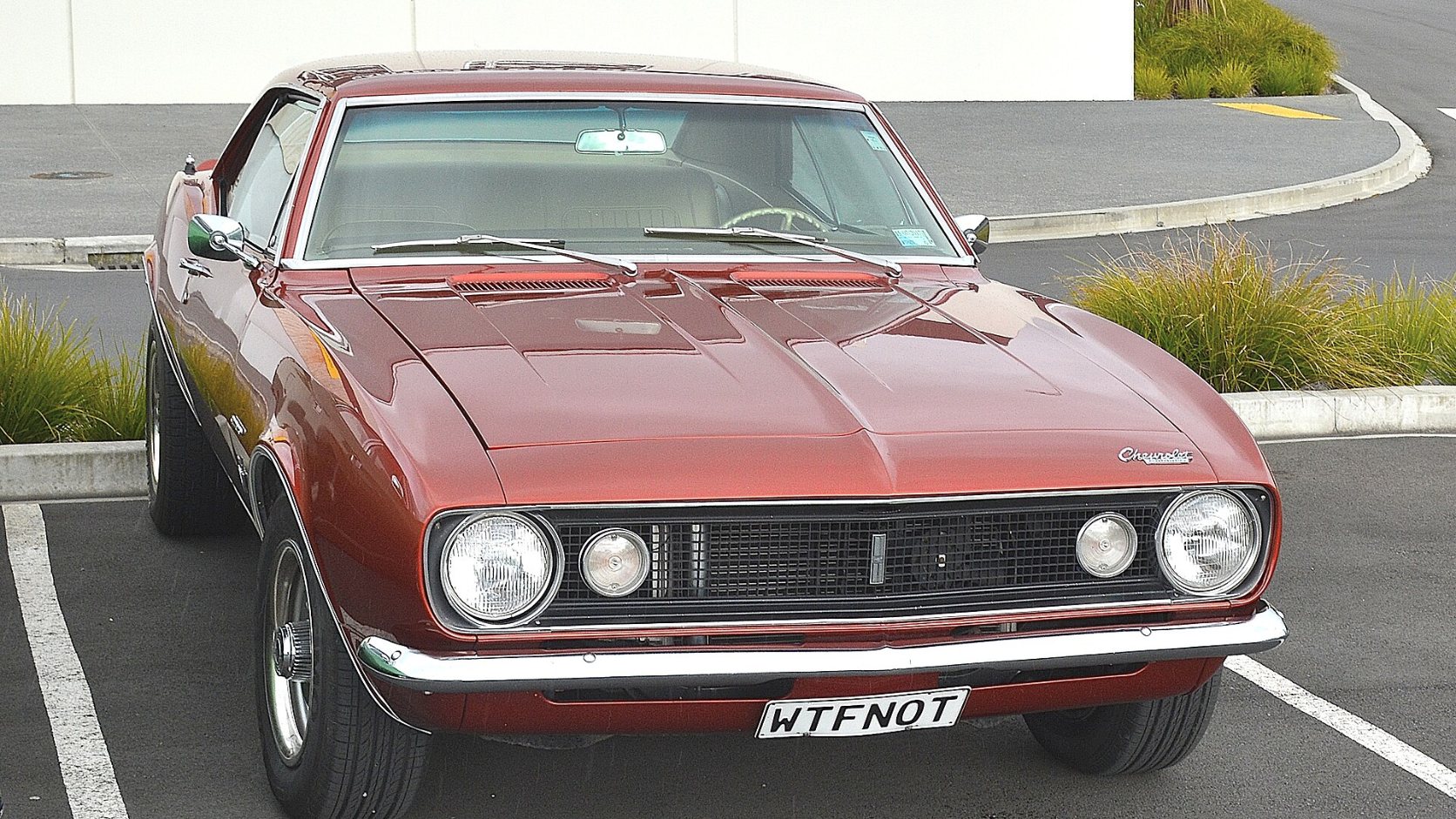
1967 Chevrolet Camaro
The 1967 Chevrolet Camaro launched Chevrolet's pony car with RS, SS and the rare Trans-Am-bred Z/28.
 1 / 6
1967 Chevrolet Camaro. Photo: GPS 56 from New Zealand via Wikimedia Commons, CC BY 2.0.
Overview
The 1967 Chevrolet Camaro was the first model year of Chevrolet’s pony car, built on the new GM F-body platform and launched in the fall of 1966 as a direct rival to the 1967 Ford Mustang. It was offered as a two-door sport coupe and a convertible.
Buyers could build a Camaro almost any way they wanted. The Rally Sport (RS) package added hidden headlights and trim upgrades, the Super Sport (SS) package brought the new 350 cubic-inch V8 or a 396 big-block, and the two could be combined. A Camaro RS/SS convertible paced the 1967 Indianapolis 500.
The most important addition was the Z/28, created so Chevrolet could race in the SCCA Trans-Am series. It used a high-revving 302 cubic-inch V8, a four-speed manual and upgraded suspension, and only 602 were built in 1967, which makes it one of the rarest early Camaros.
With more than 220,000 cars sold in its first year, the 1967 Camaro gave Chevrolet a lasting place in the pony car market and set the pattern for every Camaro that followed.
1967 Camaro timeline
- 1965Earlier development
- 1966Previous model year
- 1967Featured model year
- 1968Continued evolution
Engine options
| Engine | Type | Horsepower | Torque | Fuel / induction | Notes |
|---|---|---|---|---|---|
| 230 Turbo-Thrift | I6 | 140 hp | 220 lb-ft | 1-barrel carburetor | Base engine |
| 250 Turbo-Thrift | I6 | 155 hp | 235 lb-ft | 1-barrel carburetor | Optional six |
| 327 Turbo-Fire | V8 | 210 hp | 320 lb-ft | 2-barrel carburetor | Base V8 |
| 327 Turbo-Fire (L30) | V8 | 275 hp | 355 lb-ft | 4-barrel carburetor | Optional |
| 350 Turbo-Fire (L48) | V8 | 295 hp | 380 lb-ft | 4-barrel carburetor | SS 350 |
| 396 Turbo-Jet (L35) | V8 | 325 hp | 410 lb-ft | 4-barrel carburetor | SS 396 |
| 396 Turbo-Jet (L78) | V8 | 375 hp | 415 lb-ft | 4-barrel Holley carburetor | Top SS 396 option |
| 302 (Z/28) | V8 | 290 hp (advertised) | 290 lb-ft | 4-barrel Holley carburetor | Z/28 only, 602 built |
Specifications at a glance
Production
- Sport Coupe195,765 (88.6%)
- Convertible25,141 (11.4%)
Dimensions
Original colors
Color research in progress.
Performance
Buyer’s guide highlights
- Check the rear quarters, trunk floor, floor pans, cowl and subframe mounts for rust.
- Verify a claimed RS, SS or Z/28 with the trim tag, VIN and paperwork, since 1967 tags do not fully prove an SS or Z/28.
- Look for the original engine and transmission stampings on high-value cars.
- Check the front subframe and rear leaf springs for damage, sag and poor repairs.
- Inspect RS hidden-headlight doors for correct operation.
- Buy on documentation and originality; real Z/28 and big-block cars carry a large premium.
1. Check for Rust
Inspect any 1967 Chevrolet Camaro for rust in the rear quarter panels, trunk floor, floor pans, lower fenders, cowl and around the front and rear glass.
2. Authenticate RS, SS and Z/28 Cars
First-year trim tags give limited option information, so a real SS or Z/28 is best proven with original paperwork, correct engine codes and model-specific parts. Clones are common.
3. Check the Drivetrain
Look for matching engine and transmission stampings, and listen for worn valvetrain, smoke and noisy rear axles. The 302 and 396 engines are expensive to rebuild correctly.
4. Inspect the Subframe and Suspension
Check the bolt-on front subframe, its body mounts and the single-leaf rear springs used on many 1967 cars for damage, sag and wheel hop repairs.
5. Buy the Best Example You Can
Restoration parts are widely available, but a solid, documented car is almost always cheaper than restoring a rusty one.
Values
1967 Chevrolet Camaro values are highest for documented Z/28s and SS 396 cars, followed by RS/SS convertibles and SS 350s; six-cylinder and base 327 coupes are the most affordable.
Market references are research guides, not appraisals. Actual value depends on condition, originality, documentation, drivetrain, options, location and current buyer demand.