1973 Ford Mustang
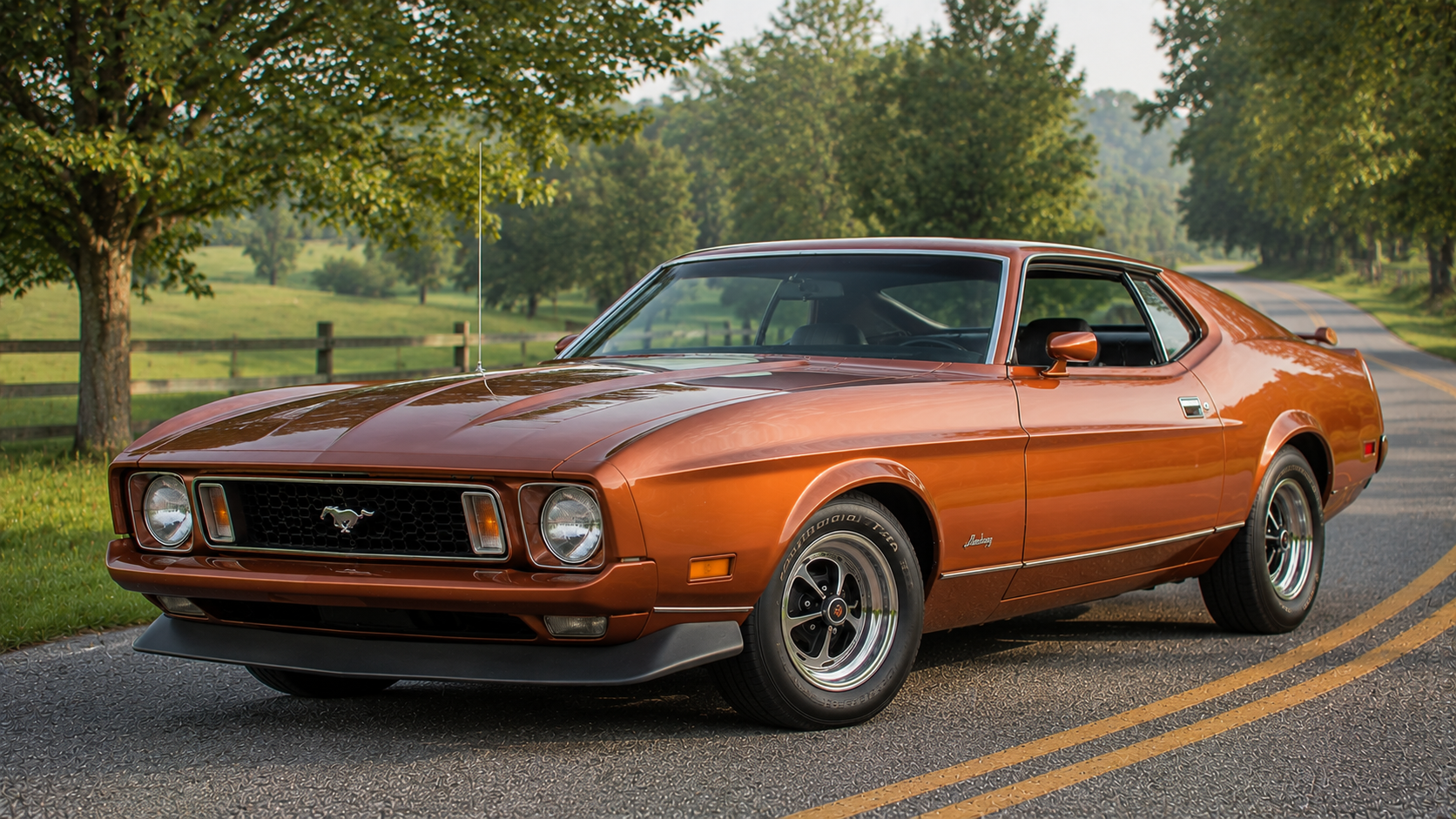
The 1973 Ford Mustang was the final model year of the first generation, combining the large 1971–1973 body with a simplified engine lineup and revised impact-resistant bumpers.
 1 / 6
Overview
The 1973 Ford Mustang marked the end of the original first-generation Mustang, closing a remarkable nine-year chapter that had begun with Ford’s groundbreaking pony car in the mid-1960s. Compared with the 1972 Ford Mustang, the basic body remained familiar, but federally mandated bumper requirements resulted in a larger body-color urethane front bumper and contributed to an increase in overall length and weight.
Ford continued to offer hardtop coupe, SportsRoof and convertible body styles, along with the luxury-oriented Grande and performance-styled Mach 1. The Mach 1 remained visually distinctive with its SportsRoof body, unique grille treatment, competition suspension and available NASA-style hood, while the Grande continued to appeal to buyers looking for additional luxury and interior trim.
The engine lineup reflected the changing performance environment of the early 1970s. The standard 250-cubic-inch inline-six was rated at 98 SAE net horsepower, while the optional 302 V8 produced 140 horsepower. Buyers seeking additional torque could select the 351 Cleveland 2V, and the Q-code 351 Cobra Jet represented the strongest widely available performance engine with 266 SAE net horsepower and 301 lb-ft of torque.
The difference from earlier cars such as the 1971 Ford Mustang was increasingly apparent. High-compression Boss and big-block engines had disappeared, emissions requirements had become more influential and Ford was preparing an entirely different Mustang for 1974. Even so, the 1973 model retained the long hood, broad stance and dramatic SportsRoof profile that characterized the final years of the original generation.
Today, the 1973 Ford Mustang is significant as the final first-generation model and the last Mustang convertible until the 1983 model year. Standard hardtops remain relatively accessible, while attractive SportsRoofs, Mach 1s, well-preserved convertibles and documented Q-code Cobra Jet cars generally attract stronger collector interest. Configuration-specific collector values can be researched through the Hagerty 1973 Ford Mustang guide.
1973 Mustang timeline
- 1971Earlier development
- 1972Previous model year
- 1973Featured model year
- 1974Continued evolution
Engine options
| Engine | Type | Horsepower | Torque | Fuel / induction | Notes |
|---|---|---|---|---|---|
| 250 cu in (4.1L) | Inline-6 | 98 hp | 197 lb-ft | 1-barrel carburetor | L-Code standard engine; SAE net rating |
| 302 cu in (4.9L) Windsor | V8 | 140 hp | 239 lb-ft | 2-barrel carburetor | F-Code small-block V8; standard in Mach 1 |
| 351 cu in (5.8L) Cleveland | V8 | 177 hp | 284 lb-ft | 2-barrel carburetor | H-Code 351 Cleveland 2V |
| 351 cu in (5.8L) Cobra Jet | V8 | 266 hp | 301 lb-ft | 4-barrel carburetor | Q-Code 351 Cleveland Cobra Jet; top regular-production performance engine |
Specifications at a glance
Production
- Hardtop76,754 (56.9%)
- SportsRoof46,260 (34.3%)
- Convertible11,853 (8.8%)
Dimensions
Original colors
Performance
Buyer’s guide highlights
- Inspect the floor pans, frame rails, torque boxes, shock towers, trunk floor and cowl carefully for structural rust and previous repairs.
- Check the cowl and front footwells for water intrusion, and examine the large body panels and bumper mounting areas for concealed corrosion or collision damage.
- Verify the VIN, data plate, engine and transmission carefully, particularly on Mach 1 and Q-code 351 Cobra Jet cars.
- Inspect the 1973-specific urethane front bumper and surrounding trim for deterioration, damage and poorly repaired impact-related problems.
- Evaluate steering, suspension, brakes, wiring and restoration workmanship carefully because the 1971–1973 Mustang is substantially larger and heavier than earlier models.
- Buy primarily on structural condition, authenticity and documentation; genuine Mach 1, Q-code Cobra Jet and well-preserved convertible examples deserve additional verification.
1. Inspect Carefully for Structural Rust
Structural condition should be the first priority when evaluating a 1973 Ford Mustang. Inspect the floor pans, front and rear frame rails, torque boxes, rocker areas, shock towers, trunk floor and rear quarter structure carefully. Repairing widespread structural corrosion on one of these large-bodied Mustangs can quickly become more expensive than purchasing a better car initially.
Examine the underside for overlapping patch panels, crude welding, excessive seam sealer and fresh undercoating that may conceal previous repairs. Pay particular attention to suspension mounting points and the areas around the torque boxes and front structure.
2. Check the Cowl and Previous Body Repairs
Cowl corrosion remains an important concern on the 1973 Mustang. Moisture and debris trapped inside the cowl can cause hidden rust and eventually allow water into the passenger compartment, where it can damage the floor pans.
Check the carpets, firewall and front footwells for dampness, staining and previous repairs. The long hood, broad quarter panels and large SportsRoof body should also be examined for body filler, inconsistent panel gaps and evidence of earlier collision repairs.
3. Verify the VIN, Data Plate and Drivetrain
Correct identification is particularly important when buying a higher-value 1973 Mustang. Decode the VIN and certification label and compare the body style, engine code, transmission, original paint and trim information with the vehicle being advertised.
An L-code six-cylinder, F-code 302, H-code 351 and Q-code 351 Cobra Jet represent substantially different specifications and values. Mach 1 appearance items can also be added to an ordinary SportsRoof, so stripes, wheels and hood treatments alone should never be considered proof of an original Mach 1.
4. Inspect the 1973 Bumpers and Exterior Trim
The 1973 Mustang received a substantial body-color urethane front bumper designed around new federal impact requirements. This makes the bumper, its mounting structure and surrounding front sheet metal important year-specific inspection points.
Look for deterioration, distortion, cracking, poor refinishing and evidence of previous impacts. Replacement or restoration of unique trim and exterior components can add considerably to the cost of returning an otherwise complete car to factory-style condition.
5. Evaluate Steering, Suspension, Brakes and Restoration Quality
The 1971–1973 Mustang is larger and heavier than the earliest first-generation cars, so worn steering, suspension and braking components can significantly affect how the car drives. During a road test, check for wandering, excessive steering play, vibration, suspension noise and uneven braking.
Many surviving examples have received replacement engines, ignition upgrades, aftermarket wheels, brake modifications or other changes. Modifications are not automatically undesirable, but wiring, welding, suspension work and mechanical installations should all be inspected for safe and professional workmanship.
6. Buy Condition, Authenticity and Documentation First
Standard hardtops generally provide an affordable route into 1973 Mustang ownership, while SportsRoofs and Mach 1 models typically receive stronger collector interest. Convertibles are also historically significant because 1973 was the final year for a first-generation Mustang convertible, and the body style would not return until 1983.
Q-code Cobra Jet cars deserve particularly careful authentication, but rarity should never outweigh structural condition. A solid, correctly represented and well-documented Mustang will usually make a better long-term purchase than a supposedly rare example suffering from serious rust, questionable identification or poor restoration work.
Values
1973 Ford Mustang values vary considerably by body style and drivetrain, with standard coupes remaining relatively accessible while SportsRoofs, Mach 1s, convertibles and genuine Q-code Cobra Jet cars attract stronger collector interest.
| Variant / body style | Market reference | Reference value (USD) | Context |
|---|---|---|---|
| Hardtop 302 V8 | Hagerty Price Guide | $13,200 | #3 Good condition benchmark, 302 cu in / 140 hp 2-barrel |
| SportsRoof 351 V8 2V | Hagerty Price Guide | $20,900 | #3 Good condition benchmark, 351 cu in / 177 hp 2-barrel |
| Convertible 351 V8 2V | Hagerty Price Guide | $22,900 | #3 Good condition benchmark, 351 cu in / 177 hp 2-barrel |
| SportsRoof 351 Cobra Jet | Hagerty Price Guide | $24,800 | #3 Good condition benchmark, Q-code 351 cu in / 266 hp 4-barrel |
Market references are research guides, not appraisals. Actual value depends on condition, originality, documentation, drivetrain, options, location and current buyer demand.