1974 Ford Mustang II
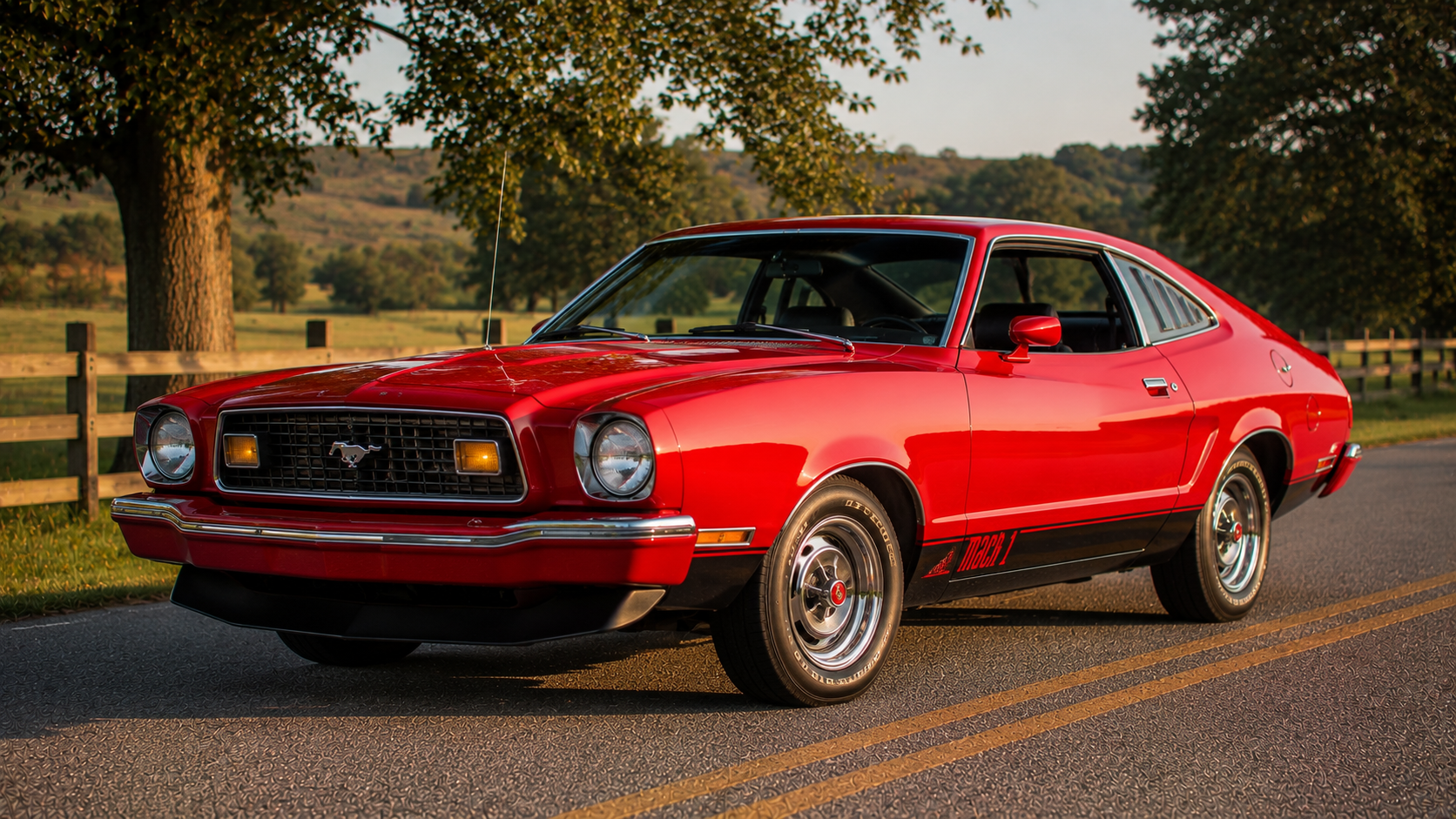
The 1974 Ford Mustang II launched the second Mustang generation with dramatically smaller dimensions, four-cylinder and V6 engines, and coupe or hatchback body styles.
 1 / 6
Overview
The 1974 Ford Mustang II introduced the second generation of Ford’s Mustang and represented one of the most dramatic changes in the model’s history. After the increasingly large first-generation cars represented by the 1973 Ford Mustang, Ford returned the Mustang to a much smaller package with a 96.2-inch wheelbase and an overall length of approximately 175 inches.
The Mustang II was offered as a two-door hardtop coupe and a three-door 2+2 hatchback. Buyers could also choose the luxury-oriented Ghia coupe, while the Mach 1 returned as a sporty hatchback model. Despite carrying familiar Mustang names, the 1974 car had completely different proportions and engineering from the previous generation.
Performance was no longer the central theme. The standard engine was a 2.3-liter overhead-cam four-cylinder producing 88 SAE net horsepower, while an optional 2.8-liter V6 produced 105 horsepower. For the first time in Mustang history, there was no V8 option for the 1974 model year.
The timing of the smaller Mustang proved commercially successful. Ford sold 385,993 Mustang IIs for 1974, a major increase over the final years of the first generation. The car also earned MotorTrend’s 1974 Car of the Year award and helped reposition the Mustang for an era increasingly concerned with fuel economy, emissions and compact dimensions.
Today, the 1974 Mustang II represents an important turning point in Mustang history. While it has traditionally attracted less collector attention than early V8 Mustangs, surviving original cars have become increasingly interesting to enthusiasts because of their distinctive styling, relative rarity and historical significance. Current collector-market information can be researched through the Hagerty 1974 Ford Mustang II guide.
1974 Mustang II timeline
- 1972Earlier development
- 1973Previous model year
- 1974Featured model year
- 1975Continued evolution
Engine options
| Engine | Type | Horsepower | Torque | Fuel / induction | Notes |
|---|---|---|---|---|---|
| 2.3L (140 cu in) Lima | Inline-4 | 88 hp | 116 lb-ft | 2-barrel carburetor | Y-Code standard engine; overhead-cam four-cylinder with SAE net rating |
| 2.8L (171 cu in) Cologne | V6 | 105 hp | 140 lb-ft | 2-barrel carburetor | Z-Code optional V6 and standard Mach 1 engine; SAE net rating |
Specifications at a glance
Production
- Hardtop Coupe177,671 (46.0%)
- Ghia Coupe89,477 (23.2%)
- 2+2 Hatchback74,799 (19.4%)
- Mach 1 Hatchback44,046 (11.4%)
Dimensions
Original colors
Performance
Buyer’s guide highlights
- Inspect the unibody floor pans, front structure, rear frame areas and suspension mounting points carefully for corrosion or poorly repaired damage.
- Check the hatch or trunk area, door bottoms, wheel openings and lower body panels for rust, water intrusion and previous body repairs.
- Verify the VIN, body style, engine and trim carefully, especially when evaluating a Ghia or Mach 1 with claimed original equipment.
- Remember that the 1974 Mustang II was never factory-equipped with a V8, so any V8-powered example has been modified or converted.
- Inspect the steering, suspension, brakes, cooling system and aging electrical components carefully before purchasing a long-stored example.
- Buy primarily on condition, completeness and originality because Mustang II-specific trim, interior pieces and body components can be difficult to replace.
1. Inspect the Unibody and Structural Areas
Structural condition should be a priority when inspecting a 1974 Ford Mustang II. Examine the floor pans, front structure, suspension mounting areas and rear underbody carefully for corrosion, previous accident damage and poorly executed repairs.
Because Mustang IIs were inexpensive used cars for many years, some surviving examples received temporary rust repairs rather than comprehensive restorations. Look underneath the vehicle for overlapping patches, crude welding, excessive filler and fresh coatings that may conceal corrosion.
2. Check the Body for Rust and Water Damage
Inspect the lower doors, wheel openings, rocker areas and lower quarter panels carefully. On hatchback models, examine the rear hatch opening, cargo floor and surrounding areas for signs of water intrusion and corrosion.
Check panel alignment and paint consistency as well. Replacement Mustang II body panels are generally less plentiful than equivalent components for popular 1960s Mustangs, making a complete and structurally sound body especially desirable.
3. Verify the VIN, Engine and Trim
The 1974 lineup included standard hardtop and hatchback models along with the luxury Ghia and sporty Mach 1. Verify the VIN and available identification information against the body style, engine and equipment being advertised.
Mach 1 graphics and exterior details can be reproduced, so appearance alone should not establish authenticity. Original documentation, ownership records and period equipment can make an unusually well-preserved Mustang II more desirable.
4. Remember That 1974 Had No Factory V8
The 1974 Mustang II was offered with only two engines: the standard 2.3-liter four-cylinder and optional 2.8-liter V6. No factory V8 Mustang II was produced for the 1974 model year.
V8 conversions are relatively common because later Mustang IIs offered V8 power and the chassis became popular for hot-rodding. A professionally converted car may be enjoyable to drive, but it should not be represented as an original 1974 V8 Mustang.
5. Inspect the Mechanical and Electrical Systems
Many Mustang IIs have accumulated long periods of storage rather than continuous use. Inspect the cooling system, fuel system, brakes, steering, suspension bushings, wheel bearings and electrical connections carefully before assuming that a low-mileage or long-stored example is road ready.
During a test drive, watch for overheating, steering play, vibration, uneven braking and transmission problems. Age-related deterioration can affect rubber hoses, seals, bushings and wiring even when overall mileage is relatively low.
6. Buy Condition, Completeness and Originality
Because restoration support for the Mustang II is not as extensive as it is for early first-generation Mustangs, completeness can be particularly important. Missing interior trim, model-specific moldings, original wheel covers and other small components can require considerable searching.
A complete, structurally sound and accurately represented car is therefore usually preferable to a cheaper incomplete project. Ghia and Mach 1 models can receive additional collector interest, but condition and originality should remain central to the buying decision.
Values
1974 Ford Mustang II values remain relatively accessible, although exceptionally original cars and desirable Ghia or Mach 1 examples can command premiums over ordinary four-cylinder and V6 models.
| Variant / body style | Market reference | Reference value (USD) | Context |
|---|---|---|---|
| Hardtop Coupe V6 | Hagerty Price Guide | $12,700 | #3 Good condition benchmark, 171 cu in / 105 hp V6 |
| Hardtop Coupe Four-Cylinder | Hagerty adjustment | Approx. $10,200 | Four-cylinder configuration based on Hagerty's -20% engine adjustment from V6 benchmark |
Market references are research guides, not appraisals. Actual value depends on condition, originality, documentation, drivetrain, options, location and current buyer demand.