1978 Ford Mustang II
The 1978 Ford Mustang II was the last of the second generation and introduced the limited-production, V8-only King Cobra.
 1 / 6
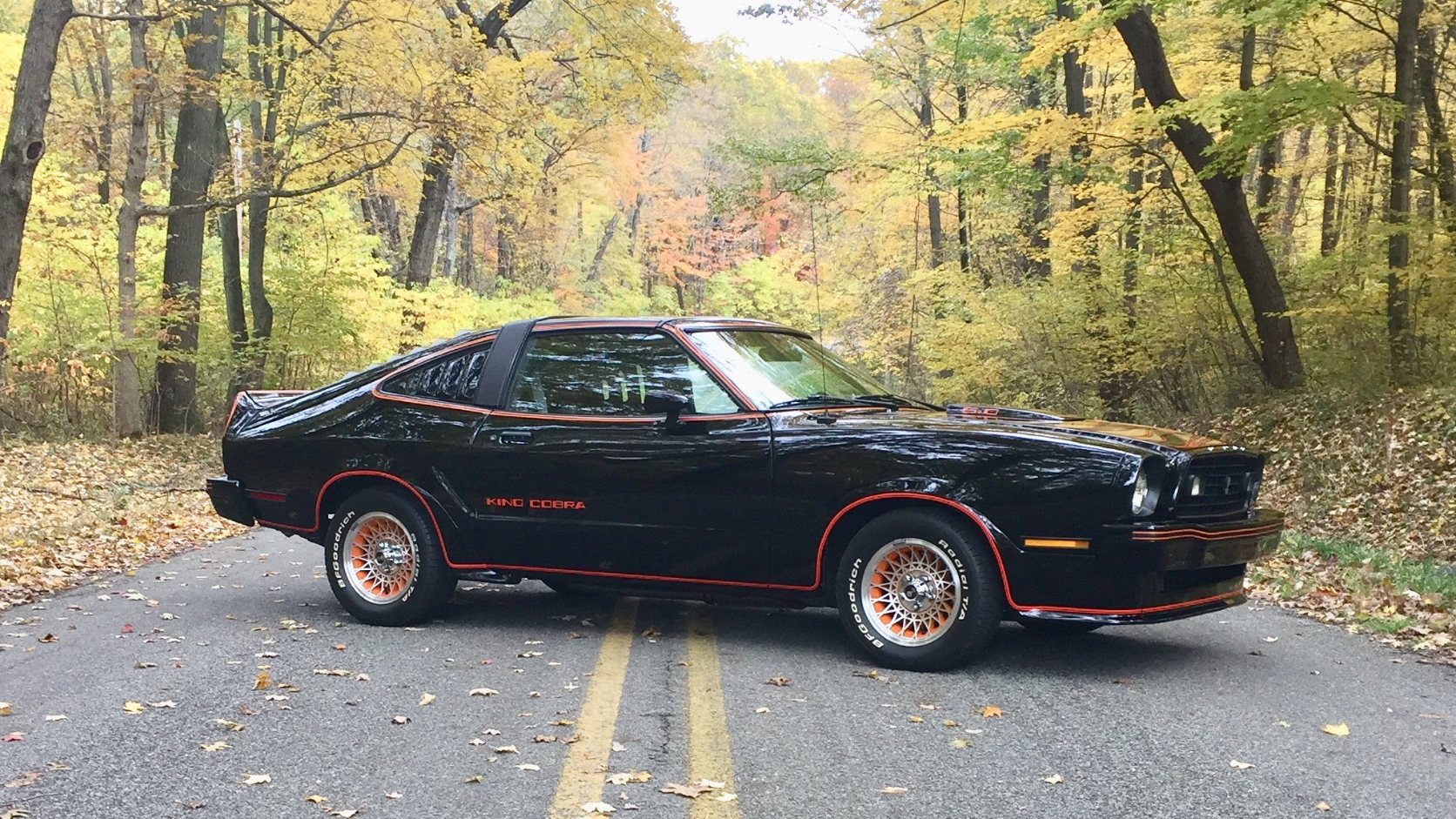
1978 Ford Mustang II King Cobra in black. Photo: avionx (Matthew P) via Flickr, public domain.
Overview
The 1978 Ford Mustang II was the final year of the second-generation Mustang, and it went out with its most dramatic model. Building on the 1977 Ford Mustang II, Ford added the limited-production King Cobra, a V8-only hatchback with a deep front air dam, a rear spoiler, bold stripes and a large cobra decal across the hood.
The King Cobra was built in small numbers, with sources putting production at roughly 4,300 to 5,000 cars, and it has become the most collectible Mustang II. The regular Cobra II also continued with revised graphics, including a reversed hood scoop and a single wide stripe in place of the earlier dual stripes.
Ford also offered a Fashion Accessory Package aimed at female buyers, with pinstriping, Fresno cloth seat inserts, an illuminated vanity mirror and door map pockets. Engine choices stayed familiar: the 2.3-liter four-cylinder, the 2.8-liter V6 and the 302-cubic-inch V8, which produced roughly 134 to 139 SAE net horsepower depending on the source.
Sales rebounded strongly for the last year, with Ford building 192,410 Mustang IIs for 1978, about 25 percent more than in 1977. The following year, the all-new Fox-body Mustang replaced it. For the complete generation story, see the second-generation Mustang history, or go back to where it started with the 1974 Ford Mustang II.
1978 Mustang II timeline
- 1976Earlier development
- 1977Previous model year
- 1978Featured model year
- 1979Continued evolution
Engine options
| Engine | Type | Horsepower | Torque | Fuel / induction | Notes |
|---|---|---|---|---|---|
| 2.3L (140 cu in) Lima | Inline-4 | Approx. 88–92 hp | 2-barrel carburetor | Standard engine; overhead-cam four-cylinder, SAE net rating | |
| 2.8L (171 cu in) Cologne | V6 | Approx. 90–91 hp | 2-barrel carburetor | Optional V6; SAE net rating | |
| 5.0L (302 cu in) Windsor | V8 | Approx. 134–139 hp | 2-barrel carburetor | Optional V8; standard on the King Cobra |
Specifications at a glance
Production
- Hardtop Coupe81,304 (42.3%)
- 2+2 Hatchback68,408 (35.6%)
- Ghia Coupe34,730 (18.0%)
- Mach 1 Hatchback7,968 (4.1%)
Dimensions
Original colors
Performance
Buyer’s guide highlights
- Inspect the floor pans, front frame rails, strut towers and rear suspension mounts for rust or poor accident repairs.
- Verify a claimed King Cobra with original paperwork — the graphics, air dam and spoiler are easy to add to a regular hatchback.
- Remember that the King Cobra was V8-only, so a genuine car should have a 302 V8 VIN engine code.
- Check the King Cobra air dam, spoiler and hood decal, which are often damaged or reproduction parts.
- On T-top cars, check seals, drains, headliner and floors for leaks and rust.
- Buy on condition and documentation, since special-model trim and interior parts can be hard to replace.
1. Start With the Unibody
Rust and old accident damage are the main risks on a 1978 Ford Mustang II. Check the floor pans, front frame rails, strut towers and rear spring mounts. Watch for heavy undercoating, patch panels and fresh filler.
2. Authenticate a King Cobra
The King Cobra is the most valuable 1978 model, so clones are common. A genuine car should have a 302 V8 engine code in the VIN, and the best proof is original paperwork such as the window sticker, invoice or dealer documents. Graphics, air dams and spoilers alone do not prove a real King Cobra.
3. Check Cobra II and Other Packages
The 1978 Cobra II has its own graphics and a reversed hood scoop. Confirm Cobra II, Ghia, Fashion Accessory and other packages against the car's paperwork, and check that model-specific trim is present.
4. Inspect T-Tops and Weatherstrip
T-top roofs can leak as seals age. Check the seals, drain channels and headliner, and look for water damage in the floors under the carpet.
5. Verify the Drivetrain and Chassis
Listen for timing wear on the four-cylinder and V6, and check the V8 for overheating in the tight engine bay. Worn subframe bushings, steering racks, ball joints and rear springs are common on original cars.
6. Buy the Best Example You Can
Most Mustang IIs are still affordable, but King Cobra and well-documented Cobra II cars can bring much more. Paying for a solid, documented car usually costs less than restoring a rough one.
Values
1978 Ford Mustang II values remain accessible for regular models, while documented King Cobra cars are the most sought after and typically command the highest prices of any Mustang II.
| Variant / body style | Market reference | Reference value (USD) | Context |
|---|---|---|---|
| Mustang II (1974–1978), all models | CLASSIC.com | $20,272 average | Average of recorded sales across all 1974–1978 Mustang II models; not specific to 1978 or the King Cobra |
Market references are research guides, not appraisals. Actual value depends on condition, originality, documentation, drivetrain, options, location and current buyer demand.