1985 Ford Mustang
The 1985 Ford Mustang GT gained a 210 hp four-barrel 5.0 V8, the last carbureted Mustang V8, while the SVO grew to about 205 hp.
 1 / 6
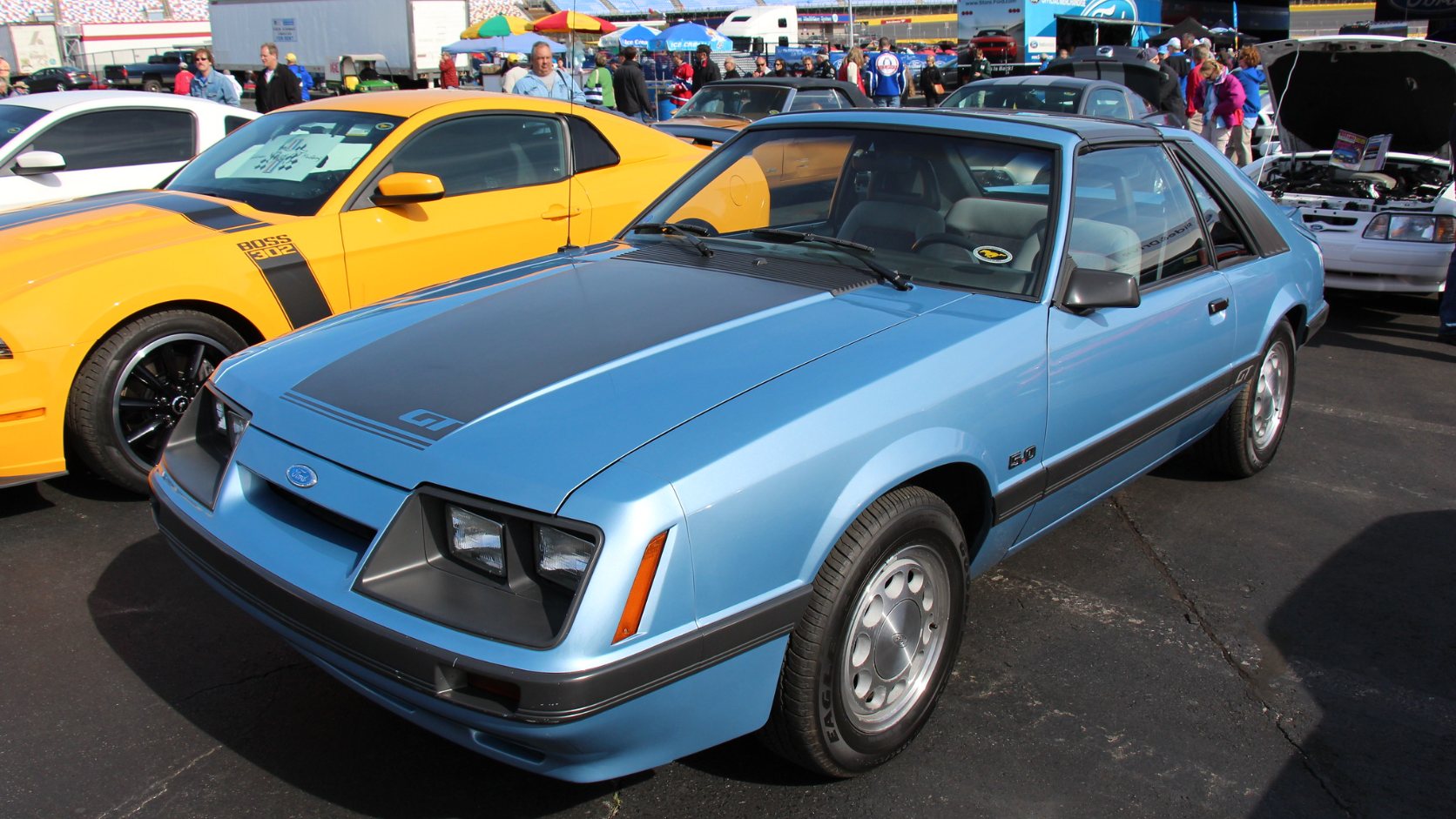
1985 Ford Mustang GT Hatchback. Photo: Sicnag via Flickr, CC BY 2.0.
Overview
The 1985 Ford Mustang was one of the strongest early Fox-body years for performance. Building on the 1984 Ford Mustang, Ford gave the car a new grille-less nose with a single horizontal air slot, and the lineup settled into the LX, the GT and the turbocharged SVO, offered as coupe, hatchback and convertible.
The 5.0-liter High Output V8 took a big step forward. With a four-barrel carburetor, roller lifters and a more aggressive camshaft, the manual-transmission version was rated at about 210 horsepower and 270 lb-ft of torque. Automatic cars used a fuel-injected 5.0 rated at about 165 to 180 horsepower. This was the last year a Mustang V8 came with a carburetor.
The SVO also improved. A mid-year update brought flush headlights and a higher-output turbocharged 2.3-liter four rated at about 205 horsepower, making the SVO one of the most sophisticated Mustangs of the decade. The base 2.3-liter four and the 3.8-liter V6 remained for buyers who wanted economy over speed.
Ford built 156,514 Mustangs for 1985. The 210-horsepower GT marked the start of the 5.0 era that made Fox-body Mustangs so popular, and clean original examples are now sought after by collectors. For more background, see the third-generation Mustang history, or compare it with the classic 1967 Ford Mustang.
1985 Mustang timeline
- 1983Earlier development
- 1984Previous model year
- 1985Featured model year
- 1986Continued evolution
Engine options
| Engine | Type | Horsepower | Torque | Fuel / induction | Notes |
|---|---|---|---|---|---|
| 2.3L (140 cu in) Lima | Inline-4 | Approx. 88 hp | 1-barrel carburetor | Base engine | |
| 2.3L (140 cu in) SVO Turbo | Turbocharged, intercooled inline-4 | Approx. 175–205 hp | Fuel injection, turbocharged | SVO only; output rose mid-year | |
| 3.8L (232 cu in) Essex | V6 | Approx. 120 hp | Fuel injection | Optional V6 | |
| 5.0L (302 cu in) H.O. | V8 | Approx. 210 hp | Approx. 270 lb-ft | 4-barrel carburetor | With five-speed manual |
| 5.0L (302 cu in) | V8 | Approx. 165–180 hp | Approx. 245 lb-ft | Central fuel injection | With automatic transmission |
Specifications at a glance
Production
- Coupe56,781 (36.3%)
- Hatchback84,623 (54.1%)
- Convertible15,110 (9.7%)
Dimensions
Original colors
Color research in progress.
Performance
Buyer’s guide highlights
- Inspect the floor pans, torque boxes, strut towers and rear frame rails for rust and accident damage.
- Confirm a claimed GT or SVO with the VIN and paperwork, since both are often copied or modified.
- Check whether the 5.0 still has its original four-barrel carburetor setup, which is unique to this era.
- On SVO cars, check the turbo, intercooler and boost control carefully.
- On convertibles, check the top, seals and floors for leaks and rust.
- Buy on condition and originality, since unmodified 1985 GTs are increasingly rare.
1. Start With Rust and Structure
Check the floor pans, torque boxes, strut towers and rear frame rails on any 1985 Ford Mustang, and look for signs of accident repair.
2. Authenticate GTs and SVOs
Check the VIN, trim tag and paperwork. The GT should have the 5.0 H.O. engine code, and the SVO has a unique turbocharged engine, front fascia and rear spoiler.
3. Check the Engine and Carburetor
Manual-transmission GTs used a four-barrel carbureted 5.0, the last carbureted Mustang V8. Many have been converted to later fuel injection, which reduces originality.
4. Inspect the Drivetrain and Suspension
Test the T-5 five-speed manual, check the clutch, and look for worn bushings, springs, shocks and steering components.
5. Buy the Best Example You Can
Original, documented 1985 GTs and SVOs are worth paying more for, as many Fox-body cars have been heavily modified.
Values
1985 Ford Mustang values are strongest for original 5.0 GT hatchbacks and SVO models, while LX coupes remain an affordable entry point.
Market references are research guides, not appraisals. Actual value depends on condition, originality, documentation, drivetrain, options, location and current buyer demand.