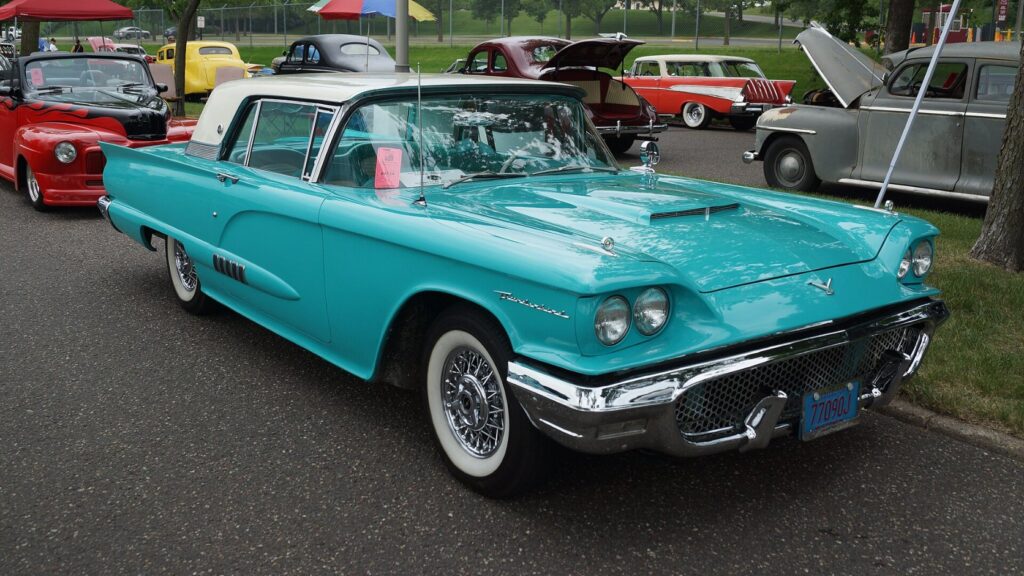
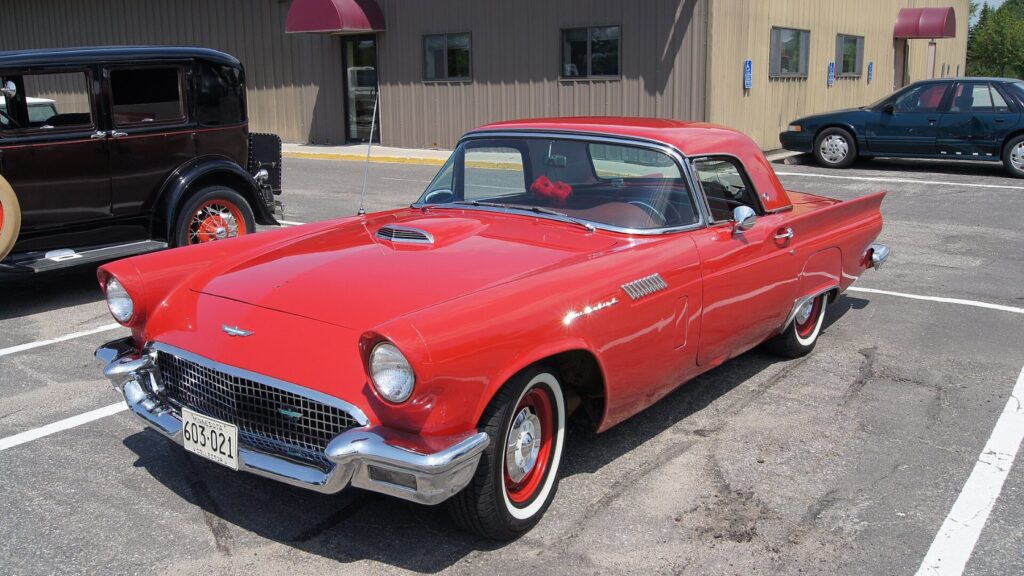
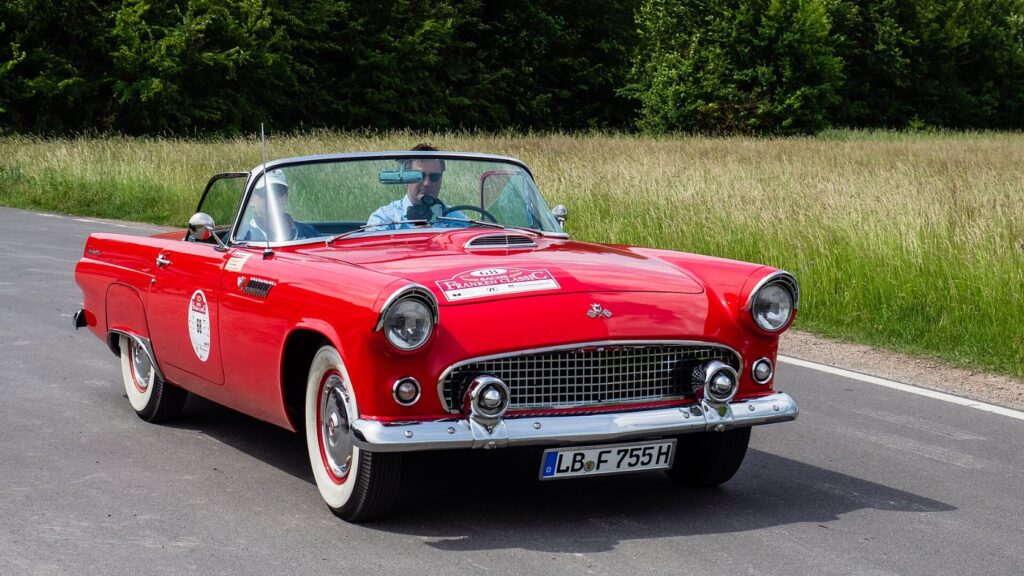
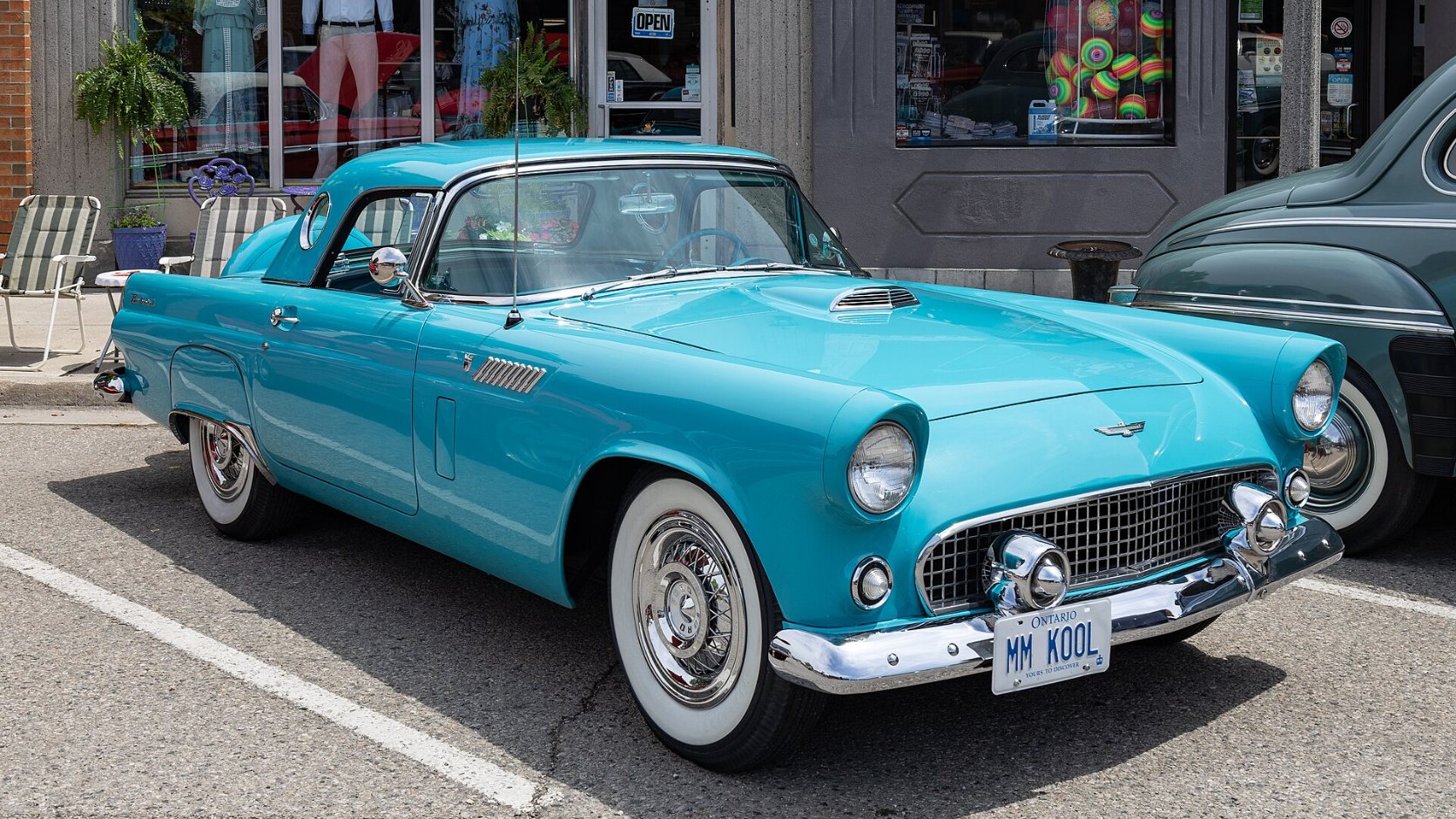
1956 Ford Thunderbird
The 1956 Ford Thunderbird added the porthole hardtop, Continental spare, 12-volt electrics and an optional 312 V8.
 1 / 6
1956 Ford Thunderbird. Photo: Crisco 1492 via Wikimedia Commons, CC BY-SA 4.0.
Overview
The 1956 Ford Thunderbird was the second year of the two-seat T-Bird. Ford kept the successful shape of the 1955 Ford Thunderbird and focused on fixing the complaints owners had raised in the first year.
The most obvious change was the spare tire, which moved to an external Continental-style mount on the rear bumper to free up trunk space. The removable hardtop could now be ordered with round porthole windows to improve the view over the shoulder, and flip-open vent doors were added to the front fenders to cool the footwells.
Ford also moved to a 12-volt electrical system and offered its Lifeguard safety features, including a deep-dish steering wheel and optional seat belts. The 292 V8 remained standard with the manual transmission, while the larger 312 cubic-inch Thunderbird Special V8 was available with up to 225 horsepower.
Production reached 15,631 cars, close to the first-year total. The porthole top and Continental spare have since become two of the best-known Thunderbird styling details.
1956 Thunderbird timeline
- 1954Earlier development
- 1955Previous model year
- 1956Featured model year
- 1957Continued evolution
Engine options
| Engine | Type | Horsepower | Torque | Fuel / induction | Notes |
|---|---|---|---|---|---|
| 292 Y-block | V8 | Approx. 202 hp | 4-barrel carburetor | Standard with 3-speed manual | |
| 312 Thunderbird Special (overdrive) | V8 | Approx. 215 hp | 4-barrel carburetor | With overdrive manual | |
| 312 Thunderbird Special (automatic) | V8 | Approx. 225 hp | 4-barrel carburetor | With Ford-O-Matic |
Specifications at a glance
Production
15,6311956 Ford Thunderbird
Dimensions
Original colors
Color research in progress.
Performance
Buyer’s guide highlights
- Check the floors, rocker panels, lower fenders, door bottoms and trunk floor for rust.
- Inspect the frame, especially around the rear spring mounts and the Continental spare mount.
- Check which tops come with the car and the condition of the porthole hardtop seals.
- Look for a correct 292 or 312 Y-block and listen for valvetrain noise.
- Check power options, gauges and the 12-volt electrical system.
- Buy on rust-free structure and completeness; trim and tops are costly.
1. Check for Rust
Inspect any 1956 Ford Thunderbird for rust in the floors, inner and outer rocker panels, lower front fenders, door bottoms and trunk floor.
2. Inspect the Frame
Look at the frame rails and rear spring mounts for corrosion. The extra weight of the Continental spare at the rear can also show up as sag or handling complaints.
3. Check the Tops
Confirm whether the car has the fiberglass hardtop, the fabric top or both, and whether the hardtop is the porthole or plain style. Check seals and latches.
4. Check the Engine
Both Y-block V8s are durable, but worn rocker shaft oiling is a known issue. Confirm whether the car has the 292 or the more desirable 312.
5. Buy the Best Example You Can
Parts and club support are excellent for two-seat Thunderbirds, but a complete, solid car is still far cheaper than a full restoration.
Values
1956 Ford Thunderbird values are strongest for correctly restored 312 cars with both tops; driver-quality cars are considerably more affordable, and rust or missing trim lowers value sharply.
Market references are research guides, not appraisals. Actual value depends on condition, originality, documentation, drivetrain, options, location and current buyer demand.