1957 Ford Thunderbird
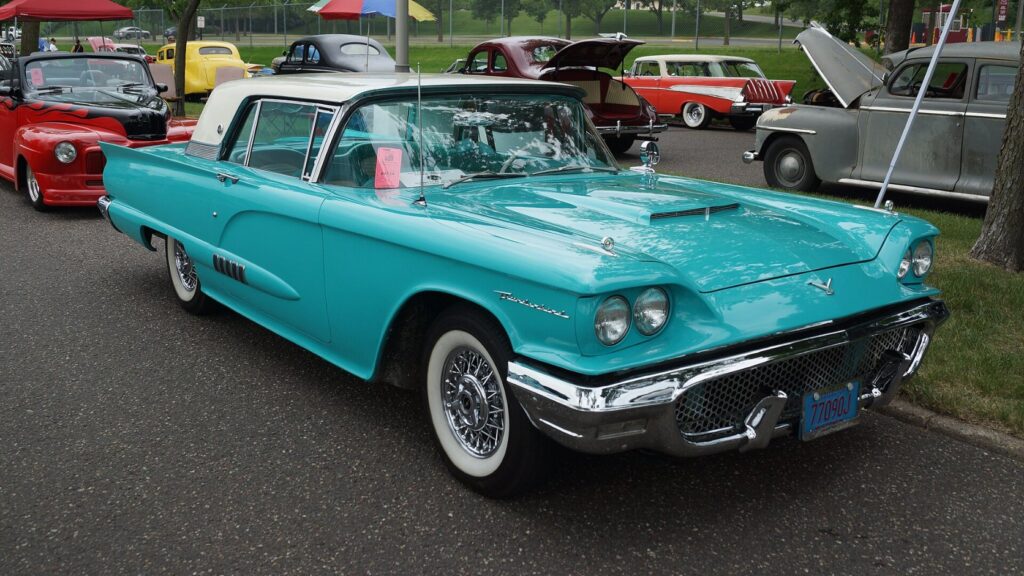
The 1957 Ford Thunderbird closed the two-seat era with tailfins, more power and the rare supercharged F-code.
 1 / 6
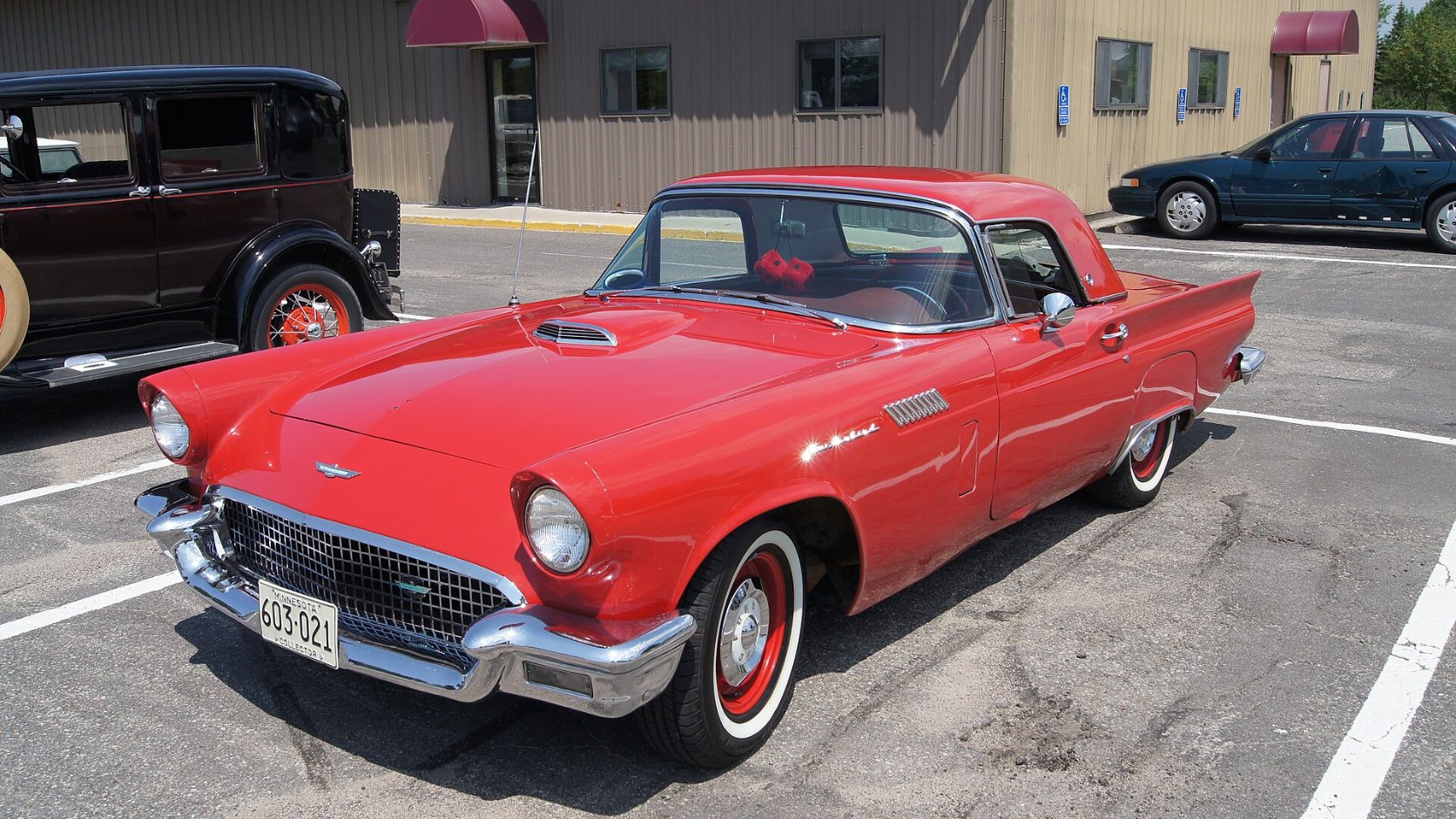
1957 Ford Thunderbird. Photo: Greg Gjerdingen from Willmar, USA via Wikimedia Commons, CC BY 2.0.
Overview
The 1957 Ford Thunderbird was the third and final year of the original two-seat T-Bird, and for many collectors it is the most desirable. It kept the basic body of the 1956 Ford Thunderbird but received a clear restyle front and rear.
The rear deck was lengthened and finished with canted tailfins, which allowed the spare tire to move back inside a larger trunk. Up front, a new bumper and a larger grille gave the car a fresh face, and the wheels dropped to 14 inches for a lower stance. The porthole hardtop remained available.
Engine choices were the widest of the two-seat years. The 292 V8 was standard with the manual transmission, and the 312 came in a 245-horsepower four-barrel version, a 270-horsepower dual four-barrel version and, in very small numbers, a supercharged version rated at 300 horsepower. These supercharged “F-code” cars are the rarest and most valuable of all early Thunderbirds.
A longer production run helped output reach 21,380 cars, the best year for the two-seater. For 1958 Ford replaced it with a larger four-seat Thunderbird, which sold far better but ended the original concept.
1957 Thunderbird timeline
- 1955Earlier development
- 1956Previous model year
- 1957Featured model year
- 1958Continued evolution
Engine options
| Engine | Type | Horsepower | Torque | Fuel / induction | Notes |
|---|---|---|---|---|---|
| 292 Y-block | V8 | Approx. 212 hp | 2-barrel carburetor | Standard with 3-speed manual | |
| 312 Thunderbird Special (D-code) | V8 | Approx. 245 hp | 4-barrel carburetor | Most common 312 | |
| 312 dual four-barrel (E-code) | V8 | Approx. 270 hp | Two 4-barrel carburetors | Performance option | |
| 312 supercharged (F-code) | V8 | Approx. 300 hp | 4-barrel carburetor with McCulloch supercharger | Very low production |
Specifications at a glance
Production
21,3801957 Ford Thunderbird
Dimensions
Original colors
Color research in progress.
Performance
Buyer’s guide highlights
- Check the floors, rocker panels, lower fenders, door bottoms and trunk floor for rust.
- Inspect the frame, especially around the rear spring mounts.
- Verify the engine code in the VIN, especially on claimed E-code and F-code cars.
- Check which tops come with the car and the condition of hardtop seals.
- Look for correct 1957-only trim, bumpers and tailfin parts.
- Buy on rust-free structure, completeness and documentation.
1. Check for Rust
Inspect any 1957 Ford Thunderbird for rust in the floors, inner and outer rocker panels, lower front fenders, door bottoms and trunk floor.
2. Inspect the Frame
Look at the frame rails and rear spring mounts for corrosion and old repairs, and check that doors, hood and trunk fit evenly.
3. Verify the Engine Code
The first character of the VIN identifies the engine. Dual-quad E-code and supercharged F-code cars are worth far more, so make sure the code and the hardware match.
4. Check the Tops and Trim
Confirm whether the car has the hardtop, the fabric top or both. Many trim pieces are specific to 1957, so check that they are present and in good condition.
5. Buy the Best Example You Can
The 1957 is the most sought-after two-seat Thunderbird, and good cars are well supported by clubs and specialists. Pay for condition and history.
Values
1957 Ford Thunderbird values are led by supercharged F-code cars by a wide margin, followed by dual-quad E-code cars; standard 312 cars in driver condition are the most affordable.
Market references are research guides, not appraisals. Actual value depends on condition, originality, documentation, drivetrain, options, location and current buyer demand.