1969 Ford Mustang
The 1969 Ford Mustang introduced a more aggressive redesign along with Mach 1, Boss models and an exceptionally broad range of six-cylinder and V8 engines.
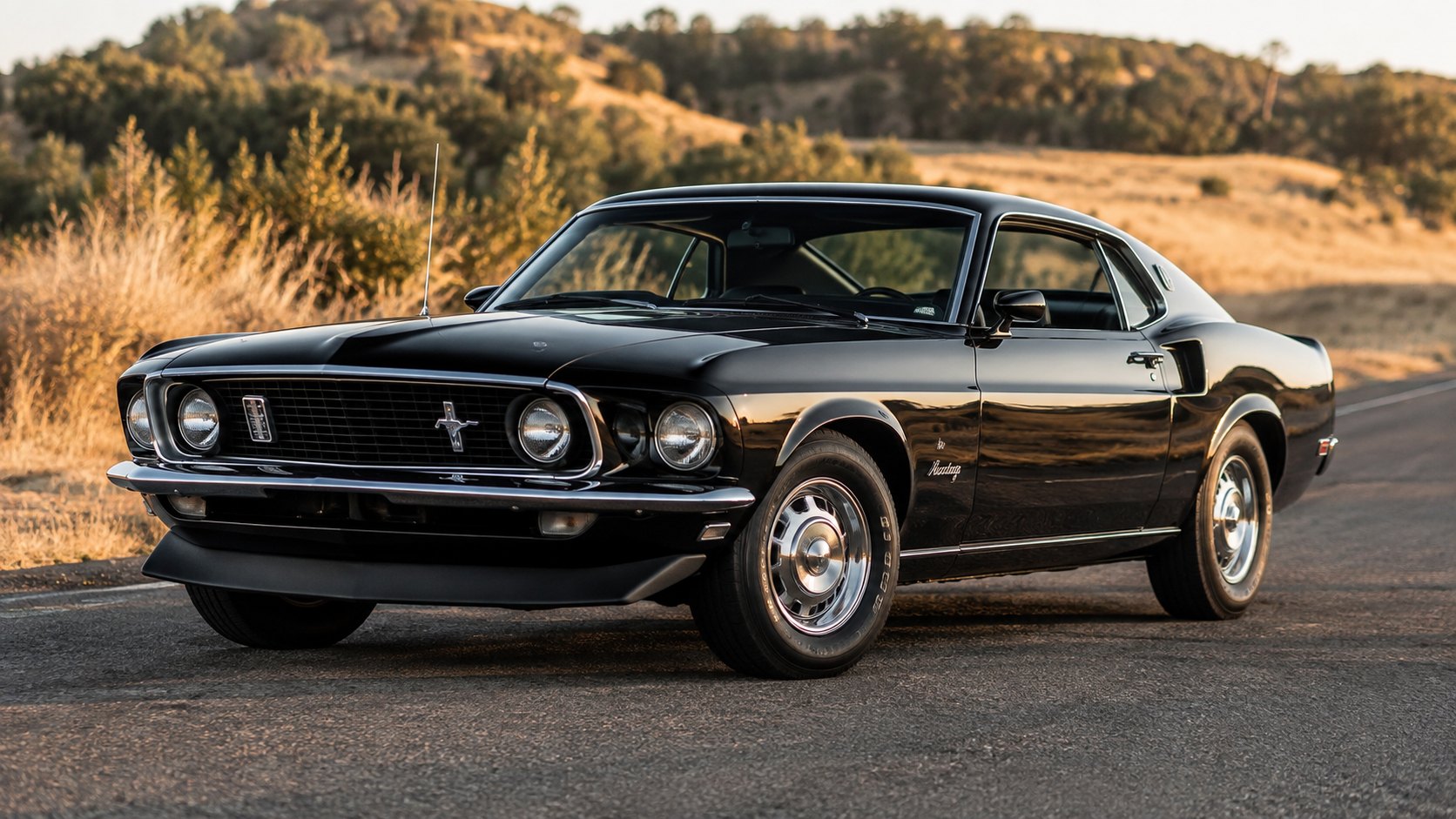 1 / 6
1 / 6
Restored 1969 Ford Mustang SportsRoof in Black Jade
Overview
The 1969 Ford Mustang marked another major evolution of Ford’s pony car, introducing a longer, lower and more aggressive body together with one of the broadest performance lineups in Mustang history. Compared with the 1968 Ford Mustang, the new model featured a dramatically revised front end with four headlights, a lower roofline and a redesigned fastback body that Ford now officially called the SportsRoof.
Ford expanded the range far beyond the standard hardtop, SportsRoof and convertible. The luxurious Grande joined the coupe lineup, while the new Mach 1 combined performance styling with upgraded trim. Even more significant were the Boss 302 and Boss 429, which connected the Mustang directly with Ford’s Trans-Am and NASCAR competition programs.
Engine choice was equally extensive. Buyers could start with economical 200- and 250-cubic-inch inline-six engines or choose from 302, 351 and 390 V8s. At the upper end were the formidable 428 Cobra Jet and Super Cobra Jet, while the specialized Boss 429 brought a 429-cubic-inch V8 officially rated at 375 horsepower.
The Mustang had changed considerably since the 1967 Ford Mustang. By 1969, Ford was no longer offering just a single sporty compact with optional performance equipment; the Mustang had developed into an entire family ranging from affordable daily transportation to some of the most collectible American muscle cars ever produced.
Today, the 1969 Ford Mustang remains especially desirable because of its distinctive styling and extraordinary number of configurations. Standard coupes remain relatively accessible, while Mach 1, Boss 302, Boss 429 and documented 428 Cobra Jet cars occupy increasingly valuable segments of the collector market. Additional specifications and current market information are available in the Hagerty 1969 Ford Mustang guide.
1969 Mustang timeline
- 1967Earlier development
- 1968Previous model year
- 1969Featured model year
- 1970Continued evolution
Engine options
| Engine | Type | Horsepower | Torque | Fuel / induction | Notes |
|---|---|---|---|---|---|
| 200 cu in (3.3L) | Inline-6 | 115 hp | 190 lb-ft | 1-barrel carburetor | T-Code standard six-cylinder engine |
| 250 cu in (4.1L) | Inline-6 | 155 hp | 240 lb-ft | 1-barrel carburetor | L-Code optional six-cylinder engine |
| 302 cu in (4.9L) | V8 | 220 hp | 300 lb-ft | 2-barrel carburetor | F-Code base V8 |
| 302 cu in (4.9L) Boss | V8 | 290 hp | 290 lb-ft | 4-barrel carburetor | G-Code Boss 302 high-performance engine |
| 351 cu in (5.8L) Windsor | V8 | 250 hp | 355 lb-ft | 2-barrel carburetor | H-Code 351 V8 |
| 351 cu in (5.8L) Windsor | V8 | 290 hp | 385 lb-ft | 4-barrel carburetor | M-Code high-output 351 V8 |
| 390 cu in (6.4L) FE | V8 | 320 hp | 427 lb-ft | 4-barrel carburetor | S-Code big-block V8 |
| 428 cu in (7.0L) Cobra Jet | V8 | 335 hp | 440 lb-ft | 4-barrel carburetor | Q-Code Cobra Jet |
| 428 cu in (7.0L) Cobra Jet Ram Air | V8 | 335 hp | 440 lb-ft | 4-barrel carburetor | R-Code; Super Cobra Jet specification available with performance axle |
| 429 cu in (7.0L) Boss | V8 | 375 hp | 450 lb-ft | 4-barrel carburetor | Z-Code Boss 429 homologation engine |
Specifications at a glance
Production
- Hardtop150,640 (50.2%)
- SportsRoof134,438 (44.8%)
- Convertible14,746 (4.9%)
Dimensions
Original colors
Performance
Buyer’s guide highlights
- Inspect the floor pans, frame rails, torque boxes, shock towers and cowl carefully for structural rust.
- Check the cowl and front footwells for water leakage, hidden corrosion and evidence of previous repairs.
- Verify the VIN, data plate and drivetrain before paying extra for a Mach 1, Boss or Cobra Jet specification.
- Authenticate Boss 302, Boss 429 and 428 Cobra Jet cars carefully because valuable performance models are frequently cloned.
- Inspect previous restorations and modifications for correct body panels, suspension work, wiring and drivetrain installation.
- Buy primarily on structural condition, authenticity and documentation; genuine SportsRoof, Mach 1 and Boss models command substantial premiums.
1. Inspect Carefully for Structural Rust
Structural condition should be one of the first priorities when evaluating a 1969 Ford Mustang. Inspect the floor pans, front and rear frame rails, torque boxes, rocker areas, shock towers and rear quarter structure carefully. Corrosion in these areas can require substantially more work than cosmetic rust on a removable panel.
Look underneath the car for patch panels, inconsistent welding, excessive seam sealer and heavy fresh undercoating. A solid body is usually worth paying more for because major structural reconstruction can quickly exceed the initial savings from buying a cheaper project.
2. Check the Cowl and Water Drainage
Like earlier first-generation Mustangs, the 1969 model can suffer from corrosion around the cowl structure. Water entering through damaged or rusted areas can reach the front footwells and eventually contribute to floor corrosion.
Inspect the carpeting and floors for moisture, staining or evidence of previous repairs. Where practical, carefully test the cowl drainage and watch inside the passenger compartment for leaks. Extensive cowl repair can involve significant disassembly and sheet-metal work.
3. Verify the VIN, Data Plate and Drivetrain
The enormous number of 1969 Mustang configurations makes correct identification especially important. Decode the VIN and data plate and compare the engine, body style, transmission, paint and trim with the car being advertised.
Documentation becomes increasingly important as the value rises. Restoration records, ownership history, invoices and specialist verification can help establish whether a car retains its original specification or has been modified during its lifetime.
4. Authenticate Boss and Cobra Jet Cars Carefully
Performance models such as the Boss 302, Boss 429 and 428 Cobra Jet occupy a much higher collector tier than an ordinary Mustang. Their desirability also makes clones and incorrectly represented cars a genuine concern.
Do not rely on stripes, spoilers, hood scoops or engine-bay appearance alone. Verify the VIN engine code, drivetrain details, model-specific equipment and available documentation. A genuine Boss or Cobra Jet car can justify a substantial premium, while a well-built tribute should be valued according to what it actually is.
5. Evaluate Restoration Quality and Modifications
Many 1969 Mustangs have received replacement engines, body panels, suspension components, wheels, brakes or electrical upgrades. Modifications do not automatically make a car undesirable, particularly when the goal is regular driving rather than strict originality.
What matters is the quality of the work. Look for properly aligned panels, sound welding, neat wiring, correctly installed mechanical components and supporting receipts. Poor restoration work can be expensive and frustrating to correct later.
6. Buy Condition, Authenticity and Documentation First
Standard hardtops generally remain the most accessible 1969 Mustangs, while SportsRoofs, Mach 1 models and genuine Boss or Cobra Jet cars can command much stronger collector interest.
Body style or engine specification should not outweigh condition. A structurally excellent and well-documented standard Mustang may be a much better purchase than a rare-looking car with major rust, questionable identification or poor restoration work. Compare condition, authenticity, drivetrain, documentation and restoration quality before deciding which example represents the best value.
Values
1969 Ford Mustang values vary enormously by body style and specification, with ordinary coupes remaining accessible while Mach 1, Cobra Jet and genuine Boss cars command major collector premiums.
| Variant / body style | Market reference | Reference value (USD) | Context |
|---|---|---|---|
| SportsRoof 302 V8 | Hagerty Price Guide | $17,300 | #3 Good condition benchmark, 302 cu in SportsRoof |
| SportsRoof 351 V8 | Hagerty Price Guide | $18,800 | #3 Good condition benchmark, 351 cu in / 250 hp SportsRoof |
| Grande 351 V8 | Hagerty Price Guide | $17,900 | #3 Good condition benchmark, 351 cu in / 250 hp Grande |
| SportsRoof 428 Super Cobra Jet | Hagerty Price Guide | $110,000 | #3 Good condition benchmark, 428 cu in Super Cobra Jet |
| Boss 429 | Hagerty Price Guide | $194,000 | #3 Good condition benchmark, 429 cu in / 375 hp Boss 429 |
Market references are research guides, not appraisals. Actual value depends on condition, originality, documentation, drivetrain, options, location and current buyer demand.