1970 Ford Mustang
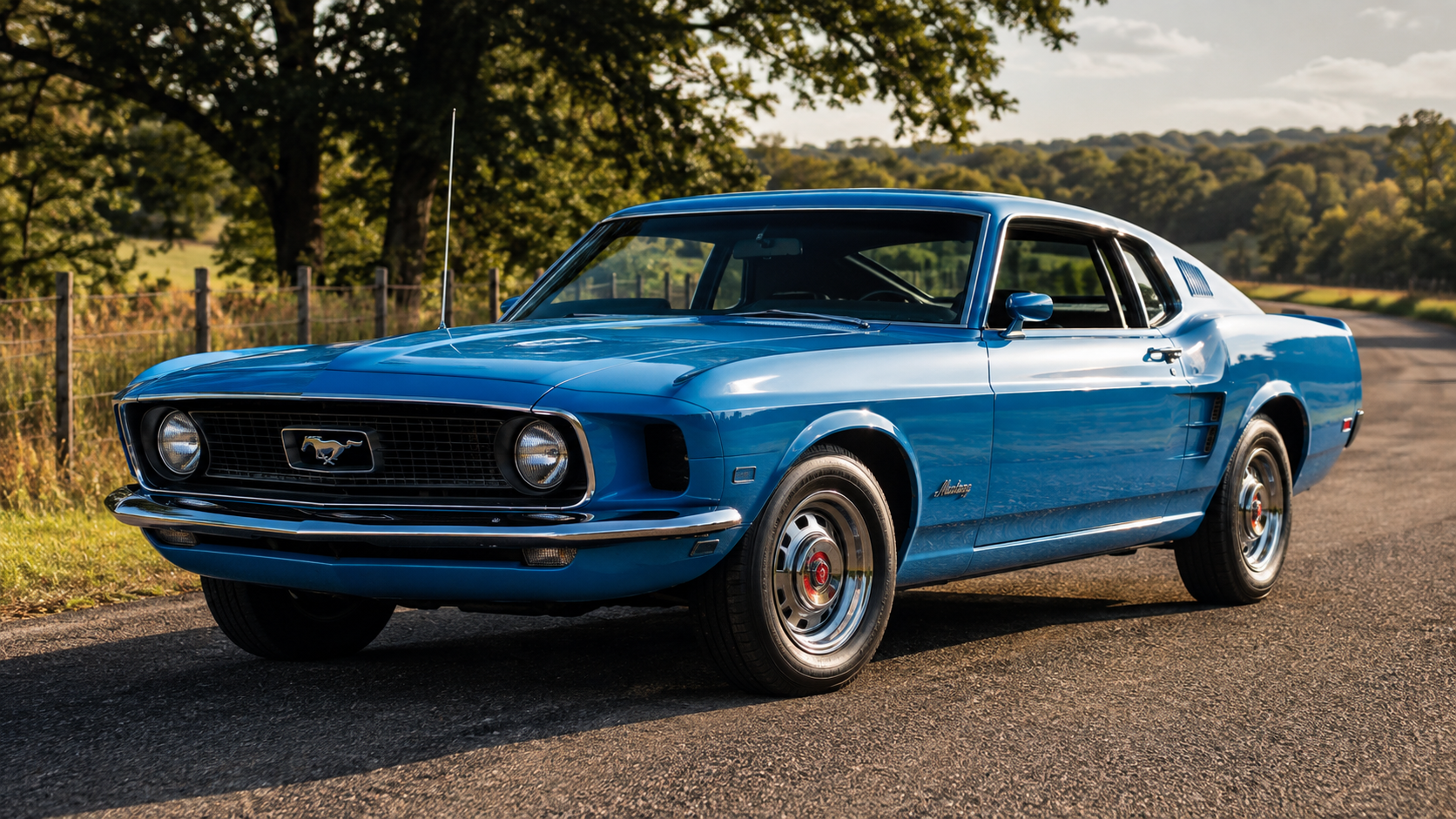
The 1970 Ford Mustang refined the aggressive 1969 design while retaining a broad performance lineup that included the Mach 1, Boss 302, Boss 429 and 428 Cobra Jet.
 1 / 6
1 / 6
Overview
The 1970 Ford Mustang refined the aggressive styling introduced a year earlier while retaining one of the broadest performance lineups of the first-generation Mustang era. Compared with the 1969 Ford Mustang, the most obvious exterior change was the return to two main headlights positioned inside the grille, replacing the previous four-headlight arrangement. Ford also removed the simulated rear-quarter scoops from SportsRoof models and revised the rear panel and trim.
The engine range remained exceptionally diverse. Buyers could choose economical 200- and 250-cubic-inch inline-six engines, a 302 V8, two 351 V8 configurations, or the formidable 428 Cobra Jet. The Boss 302 returned for another year with its high-revving 290-horsepower small-block, while the limited-production Boss 429 continued with its specialized 375-horsepower big-block V8.
Ford continued to offer hardtop coupe, SportsRoof and convertible body styles alongside more specialized versions. The upscale Grande returned, while the Mach 1 remained an important performance-oriented SportsRoof model. Boss 302 and Boss 429 versions provided an even stronger connection with Ford’s competition programs.
Although the Mustang remained highly recognizable, its market was becoming increasingly competitive. The 1968 Ford Mustang had helped establish the big-block performance formula, but by 1970 buyers could also choose from newer rivals including the Dodge Challenger and redesigned Chevrolet Camaro and Pontiac Firebird. Mustang production consequently fell sharply from the previous model year.
Today, the 1970 Ford Mustang attracts collectors because it combines mature first-generation styling with an unusually broad selection of engines and special models. Standard hardtops and SportsRoofs remain comparatively attainable, while Mach 1, 428 Cobra Jet, Boss 302 and Boss 429 examples occupy much stronger collector tiers. Additional year-specific specifications and current market information are available through the Hagerty 1970 Ford Mustang guide.
1970 Mustang timeline
- 1968Earlier development
- 1969Previous model year
- 1970Featured model year
- 1971Continued evolution
Engine options
| Engine | Type | Horsepower | Torque | Fuel / induction | Notes |
|---|---|---|---|---|---|
| 200 cu in (3.3L) | Inline-6 | 120 hp | 190 lb-ft | 1-barrel carburetor | T-Code standard six-cylinder engine |
| 250 cu in (4.1L) | Inline-6 | 155 hp | 240 lb-ft | 1-barrel carburetor | L-Code optional six-cylinder engine |
| 302 cu in (4.9L) | V8 | 220 hp | 300 lb-ft | 2-barrel carburetor | F-Code base V8 |
| 302 cu in (4.9L) Boss | V8 | 290 hp | 290 lb-ft | 4-barrel carburetor | G-Code Boss 302 high-performance engine |
| 351 cu in (5.8L) | V8 | 250 hp | 355 lb-ft | 2-barrel carburetor | H-Code 351 2V; Windsor or Cleveland depending on production |
| 351 cu in (5.8L) Cleveland | V8 | 300 hp | 385 lb-ft | 4-barrel carburetor | M-Code high-output Cleveland V8 |
| 428 cu in (7.0L) Cobra Jet | V8 | 335 hp | 440 lb-ft | 4-barrel carburetor | Q-Code Cobra Jet |
| 428 cu in (7.0L) Cobra Jet Ram Air | V8 | 335 hp | 440 lb-ft | 4-barrel carburetor | R-Code Ram-Air Cobra Jet; Drag Pack available |
| 429 cu in (7.0L) Boss | V8 | 375 hp | 450 lb-ft | 4-barrel carburetor | Z-Code Boss 429 homologation engine |
Specifications at a glance
Production
- Hardtop96,150 (50.4%)
- SportsRoof86,904 (45.6%)
- Convertible7,673 (4.0%)
Dimensions
Original colors
Performance
Buyer’s guide highlights
- Inspect the floor pans, frame rails, torque boxes, shock towers and cowl carefully for structural rust and previous repairs.
- Check the cowl and front footwells for water leaks because hidden cowl corrosion can lead to expensive structural work.
- Verify the VIN, data plate, engine and transmission before paying a premium for a Mach 1, Boss or Cobra Jet specification.
- Authenticate Boss 302, Boss 429 and 428 Cobra Jet cars carefully because valuable performance versions are frequently cloned.
- Inspect restoration quality and modifications, including body panels, wiring, suspension, brakes and replacement drivetrain components.
- Buy primarily on structural condition, authenticity and documentation; genuine Mach 1, Boss and Cobra Jet cars command major premiums.
1970 Ford Mustang Buyer's Guide
1. Inspect Carefully for Structural Rust
Structural condition should be one of the first priorities when inspecting a 1970 Ford Mustang. Pay particular attention to the floor pans, front and rear frame rails, torque boxes, rocker areas, shock towers, rear quarter structure and trunk floor. Rust in these areas can require considerably more work than cosmetic corrosion on a removable body panel.
Inspect underneath the Mustang for patch panels, inconsistent welding, heavy seam sealer and fresh undercoating that may conceal previous repairs. A structurally solid car usually represents a better starting point than a cheaper example requiring extensive metal reconstruction.
2. Check the Cowl and Front Footwells for Water Leaks
The cowl remains an important inspection point on a 1970 Mustang. Water and accumulated debris can promote corrosion inside the structure, eventually allowing moisture to enter the passenger compartment and damage the floor pans.
Check the front carpets, firewall area and floors for staining, dampness or evidence of previous repairs. Where practical, carefully test the cowl drainage while watching inside the cabin for leaks. Significant cowl corrosion can be labor-intensive to repair correctly.
3. Verify the VIN, Data Plate and Drivetrain
The 1970 Mustang was available in numerous configurations, so identification becomes increasingly important as the asking price rises. Decode the VIN and certification label and compare the body style, engine code, transmission and equipment with the car being advertised.
Documentation such as ownership records, restoration photographs, invoices and specialist reports can help establish a vehicle's history. Replacement engines and transmissions are common on cars of this age and are not automatically undesirable, but they should be represented accurately and reflected in the price.
4. Authenticate Boss and Cobra Jet Cars Carefully
Boss 302, Boss 429 and 428 Cobra Jet Mustangs occupy a much higher collector tier than ordinary 1970 models. Their desirability makes accurate authentication particularly important before paying a substantial performance-model premium.
Do not rely only on stripes, spoilers, hood scoops or a correct-looking engine. Verify the VIN engine code, model-specific equipment, drivetrain details and available documentation. A professionally built tribute can still be an enjoyable car, but it should not be valued as an original factory Boss or Cobra Jet Mustang.
5. Evaluate Restoration Quality and Modifications
Many surviving 1970 Mustangs have been restored or modified. Replacement sheet metal, upgraded brakes, modern ignition components, suspension changes, engine swaps and aftermarket wheels are common, especially on cars intended for regular driving.
Look beyond whether modifications are original and focus on workmanship. Panel gaps should be consistent, structural welding should be sound, wiring should be orderly and mechanical upgrades should be installed safely. Poor restoration work can cost more to correct than buying a better car initially.
6. Buy Condition, Authenticity and Documentation First
Standard hardtops and SportsRoofs generally provide more accessible entry points into 1970 Mustang ownership, while Mach 1, Boss and documented Cobra Jet cars receive much stronger collector interest.
Rarity should not overshadow condition. A structurally excellent and accurately represented standard Mustang may be a better purchase than a supposedly rare example with questionable identification, extensive corrosion or poor restoration work. Compare structural integrity, drivetrain specification, authenticity, documentation and overall workmanship before deciding which car represents the best value.
Values
1970 Ford Mustang values vary dramatically by body style and specification, with standard models remaining relatively accessible while Mach 1, Cobra Jet and genuine Boss models command substantial collector premiums.
| Variant / body style | Market reference | Reference value (USD) | Context |
|---|---|---|---|
| SportsRoof 302 V8 | Hagerty Price Guide | $17,500 | #3 Good condition benchmark, 302 cu in / 220 hp 2-barrel |
| Convertible 302 V8 | Hagerty Price Guide | $19,700 | #3 Good condition benchmark, 302 cu in / 220 hp 2-barrel |
| SportsRoof 351 V8 4V | Hagerty Price Guide | $40,300 | #3 Good condition benchmark, 351 cu in / 300 hp 4-barrel |
| Boss 302 | Hagerty Price Guide | $62,300 | #3 Good condition benchmark, 302 cu in / 290 hp Boss 302 |
| Convertible 428 Cobra Jet | Hagerty Price Guide | $75,300 | #3 Good condition benchmark, 428 cu in / 335 hp Cobra Jet |
| Boss 429 | Hagerty Price Guide | $173,000 | #3 Good condition benchmark, 429 cu in / 375 hp Boss 429 |
Market references are research guides, not appraisals. Actual value depends on condition, originality, documentation, drivetrain, options, location and current buyer demand.