1975 Ford Mustang II
The 1975 Ford Mustang II brought back the V8 with an optional 302 Windsor, offered alongside four-cylinder and V6 engines in coupe, Ghia, 2+2 and Mach 1 form.
 1 / 6
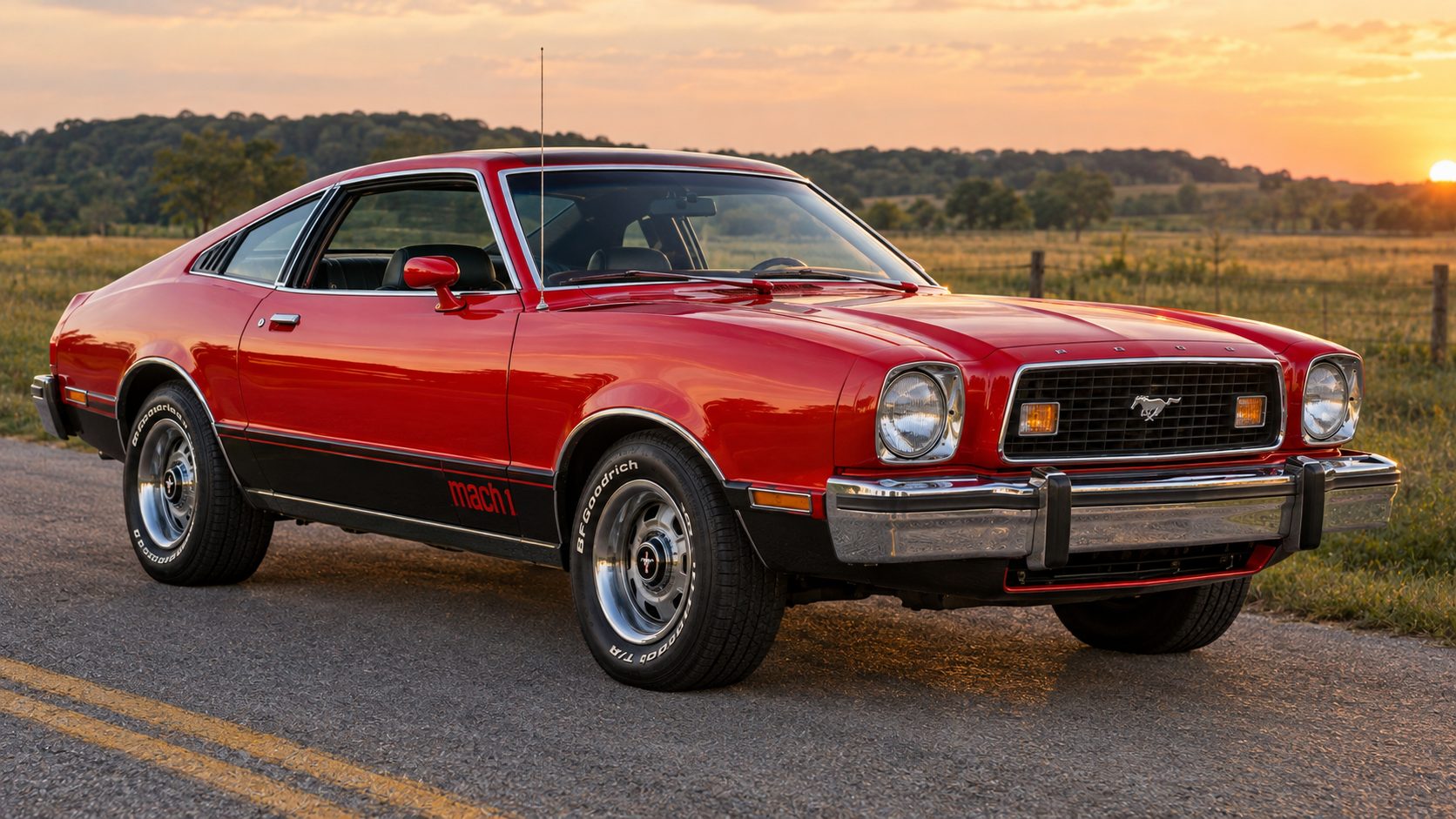
1975 Ford Mustang II Mach 1 in Bright Red with black lower-body accent
Overview
The 1975 Ford Mustang II was the second year of Ford’s compact, second-generation Mustang, and it answered the biggest complaint about the 1974 Ford Mustang II: there was a V8 again. Ford reworked the engine compartment and front structure so the 302-cubic-inch Windsor V8 could fit, and it became the top engine choice alongside the 2.3-liter four-cylinder and the 2.8-liter V6.
The V8 was modest by earlier Mustang standards. Fed by a two-barrel carburetor and tuned for emissions, it produced roughly 140 SAE net horsepower and came only with the automatic transmission, power steering and power brakes. Still, its torque transformed the car’s character compared with the smaller engines, which were now paired with catalytic converters and lost a little output in the process.
The body lineup stayed the same: a two-door hardtop coupe, the upscale Ghia coupe, a three-door 2+2 hatchback and the sporty Mach 1 hatchback. The Ghia gained a padded half vinyl roof with small opera windows, steel-belted radial tires became standard, and a fuel-economy-focused MPG model joined the range during the year.
Sales cooled after the record first season. Ford built 188,575 Mustang IIs for 1975, roughly half the 1974 total, as the initial fuel-crisis rush faded. Today the 1975 car matters to collectors as the year the Mustang II became a V8 car, setting up the Cobra II and King Cobra models that followed. For the full generation story, see the second-generation Mustang history, and compare it with the classic 1967 Ford Mustang.
1975 Mustang II timeline
- 1973Earlier development
- 1974Previous model year
- 1975Featured model year
- 1976Continued evolution
Engine options
| Engine | Type | Horsepower | Torque | Fuel / induction | Notes |
|---|---|---|---|---|---|
| 2.3L (140 cu in) Lima | Inline-4 | Approx. 83–88 hp | 2-barrel carburetor | Standard engine; overhead-cam four-cylinder, SAE net rating | |
| 2.8L (171 cu in) Cologne | V6 | Approx. 97–105 hp | Approx. 140 lb-ft | 2-barrel carburetor | Optional V6; SAE net rating |
| 5.0L (302 cu in) Windsor | V8 | Approx. 139–140 hp | Approx. 213 lb-ft | 2-barrel carburetor | New optional V8 for 1975; automatic transmission required |
Specifications at a glance
Production
- Hardtop Coupe85,155 (45.2%)
- Ghia Coupe52,320 (27.7%)
- 2+2 Hatchback30,038 (15.9%)
- Mach 1 Hatchback21,062 (11.2%)
Dimensions
Original colors
Performance
Buyer’s guide highlights
- Inspect the floor pans, front frame rails, strut towers and rear suspension mounting points for corrosion or poorly repaired accident damage.
- Check the lower doors, rocker panels, wheel openings, hatch area and trunk floor for rust and water intrusion.
- Verify the VIN engine code, especially on cars sold as original 302 V8 examples — the V8 was new for 1975 and conversions are common.
- Remember that a factory 1975 V8 came with an automatic transmission, so a V8 car with a manual gearbox has been modified.
- Check emissions equipment, cooling system, brakes and aging wiring carefully on long-stored cars.
- Buy on condition and completeness, since Ghia and Mach 1 trim, interior parts and body pieces can be hard to find.
1. Start With the Unibody
Structure matters more than anything on a 1975 Ford Mustang II. Look underneath at the floor pans, front frame rails, strut towers and rear suspension mounts. Many of these cars spent years as cheap daily drivers, so quick patch repairs, heavy undercoating and fresh filler are common warning signs.
2. Check the Body for Rust
Examine the lower doors, rocker panels, wheel openings and the bottoms of the quarter panels. On hatchback and Mach 1 models, open the hatch and check the cargo floor and seals for water damage. On Ghia coupes, inspect the edges of the vinyl roof, where trapped moisture can rust the metal underneath.
3. Confirm the Engine
The 302 V8 was the headline change for 1975, which makes V8 cars the most sought after — and the most likely to be misrepresented. Check the engine code in the VIN against the engine in the car. A factory V8 car should also have an automatic transmission, power steering and power brakes.
4. Inspect the Drivetrain and Chassis
Listen for worn timing components on the four-cylinder and V6, and check the V8 for overheating in the tight engine bay. Look at the front subframe bushings, steering rack, brakes and rear springs, which may be tired on original cars.
5. Look at Trim and Interior
Ghia and Mach 1 cars carry model-specific trim, badges and interior pieces. Check that these parts are present and in good condition, because some are expensive or difficult to replace.
6. Buy the Best Car You Can
Values for the Mustang II are still accessible, so restoration costs can easily exceed a car's market value. A well-kept original or properly restored example is usually the better buy than a cheap project.
Values
1975 Ford Mustang II values remain accessible, with original 302 V8 cars and well-kept Mach 1 and Ghia examples generally bringing more than four-cylinder and V6 models.
| Variant / body style | Market reference | Reference value (USD) | Context |
|---|---|---|---|
| Mustang II (1974–1978), all models | CLASSIC.com | $20,272 average | Average of recorded sales across all 1974–1978 Mustang II models; not specific to 1975 |
Market references are research guides, not appraisals. Actual value depends on condition, originality, documentation, drivetrain, options, location and current buyer demand.