1976 Ford Mustang II
The 1976 Ford Mustang II introduced the Shelby-inspired Cobra II package and made a four-speed manual available with the 302 V8.
 1 / 6
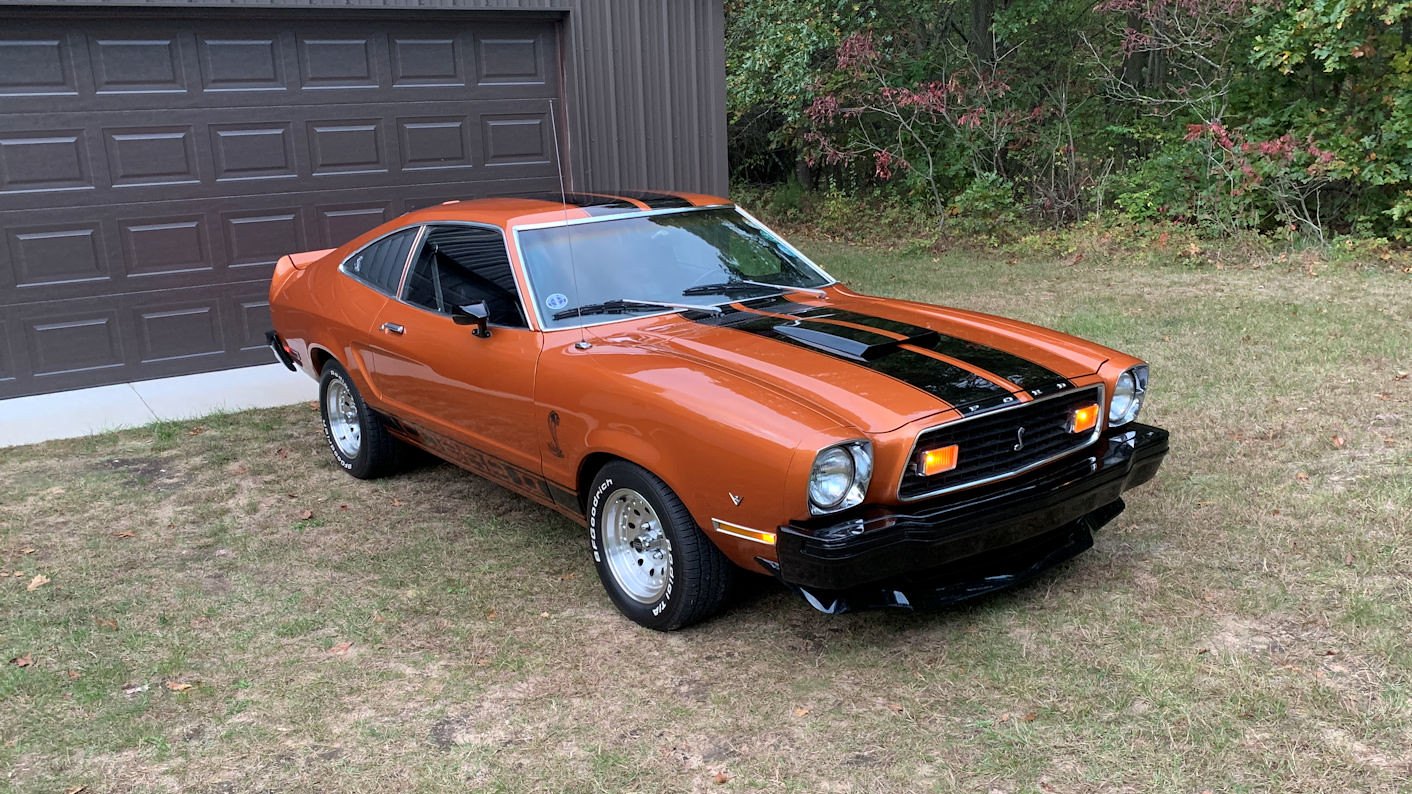
1976 Mustang II Cobra II finished in a non-factory orange tribute scheme. Photo: avionx (Matthew P) via Flickr, public domain.
Overview
The 1976 Ford Mustang II carried over the compact body and engine lineup of the 1975 Ford Mustang II, but Ford used appearance packages to give the car more personality. The biggest story was the new Cobra II, a hatchback package with bold racing stripes, a simulated hood scoop, front and rear spoilers and quarter-window louvers that recalled the Shelby Mustangs of the 1960s.
The Cobra II was offered only on the three-door hatchback and quickly became the best-known version of the car. Early examples were typically white with blue stripes, with blue-and-white and black-and-gold combinations also offered. Ford also added the Stallion appearance group, with black lower bodywork and a black grille, giving buyers another sporty look without the full Cobra II treatment.
Under the hood, the choices were familiar: a 2.3-liter four-cylinder, a 2.8-liter V6 and the 302-cubic-inch V8. The V8 still produced roughly 134 to 140 SAE net horsepower depending on the source, but it became available with a four-speed manual transmission during the model year, which made the V8 cars more appealing to enthusiasts.
Ford built 187,567 Mustang IIs for 1976, almost exactly matching 1975. The mix shifted toward hatchbacks as the Cobra II drew buyers, while Mach 1 production fell sharply. Today the 1976 Cobra II is one of the most recognizable Mustang II models. For the wider generation story, see the second-generation Mustang history, or compare it with the first-generation 1967 Ford Mustang.
1976 Mustang II timeline
- 1974Earlier development
- 1975Previous model year
- 1976Featured model year
- 1977Continued evolution
Engine options
| Engine | Type | Horsepower | Torque | Fuel / induction | Notes |
|---|---|---|---|---|---|
| 2.3L (140 cu in) Lima | Inline-4 | Approx. 88–93 hp | Approx. 98 lb-ft | 2-barrel carburetor | Standard engine; overhead-cam four-cylinder, SAE net rating |
| 2.8L (171 cu in) Cologne | V6 | Approx. 102–105 hp | Approx. 140 lb-ft | 2-barrel carburetor | Optional V6; SAE net rating |
| 5.0L (302 cu in) Windsor | V8 | Approx. 134–140 hp | Approx. 213 lb-ft | 2-barrel carburetor | Optional V8; four-speed manual became available during 1976 |
Specifications at a glance
Production
- Hardtop Coupe78,508 (41.9%)
- 2+2 Hatchback62,312 (33.2%)
- Ghia Coupe37,515 (20.0%)
- Mach 1 Hatchback9,232 (4.9%)
Dimensions
Original colors
Performance
Buyer’s guide highlights
- Inspect the floor pans, front frame rails, strut towers and rear suspension mounts for rust or poor accident repairs.
- Check the lower doors, rocker panels, wheel openings, hatch area and cargo floor for corrosion and water leaks.
- Verify that a claimed Cobra II is genuine — many cars have added stripes, scoops and louvers, so documentation matters.
- Check the VIN engine code on V8 cars, and confirm whether a manual transmission is original or a later swap.
- Look closely at Cobra II spoilers, scoop, louvers and stripes, which are often damaged, missing or reproduction parts.
- Buy on condition and completeness, since model-specific trim and interior parts can be hard to replace.
1. Start With the Unibody
Rust is the biggest threat to a 1976 Ford Mustang II. Check the floor pans, front frame rails, strut towers and rear spring mounts from underneath. Watch for patch panels, heavy undercoating and fresh filler, which can hide older damage.
2. Check the Body Panels
Inspect the lower doors, rocker panels, wheel openings and quarter panels. On hatchbacks, lift the hatch and look at the cargo floor, seals and spare-tire area for water damage. On Ghia coupes, check the edges of the vinyl roof for bubbling.
3. Confirm a Genuine Cobra II
The Cobra II look is easy to copy, so many base hatchbacks now wear Cobra II stripes and body parts. Ask for original paperwork such as the window sticker, invoice or build documentation. Original stripe colors and matching trim help, but documentation is the strongest proof.
4. Verify the Drivetrain
Check the engine code in the VIN against the engine fitted. A four-speed manual became available with the V8 during 1976, so a manual V8 car can be original, but it should still be verified. Listen for timing wear on the four-cylinder and V6, and check the V8 for overheating in the tight engine bay.
5. Inspect Suspension, Steering and Brakes
Worn front subframe bushings, steering racks, ball joints and rear springs are common on original cars. Test-drive the car to check braking, steering feel and any clunks over bumps.
6. Buy the Best Example You Can
Mustang II values are still accessible, and restoration costs can easily exceed market value. A documented, well-kept car is usually a better buy than a cheap project.
Values
1976 Ford Mustang II values remain accessible, with documented Cobra II cars and original V8 examples generally bringing more than base four-cylinder and V6 models.
| Variant / body style | Market reference | Reference value (USD) | Context |
|---|---|---|---|
| Mustang II (1974–1978), all models | CLASSIC.com | $20,272 average | Average of recorded sales across all 1974–1978 Mustang II models; not specific to 1976 |
Market references are research guides, not appraisals. Actual value depends on condition, originality, documentation, drivetrain, options, location and current buyer demand.