1980 Ford Mustang
The 1980 Ford Mustang swapped the 302 V8 for a fuel-saving 4.2-liter V8, leaving the turbocharged four as the most powerful engine in the lineup.
 1 / 6
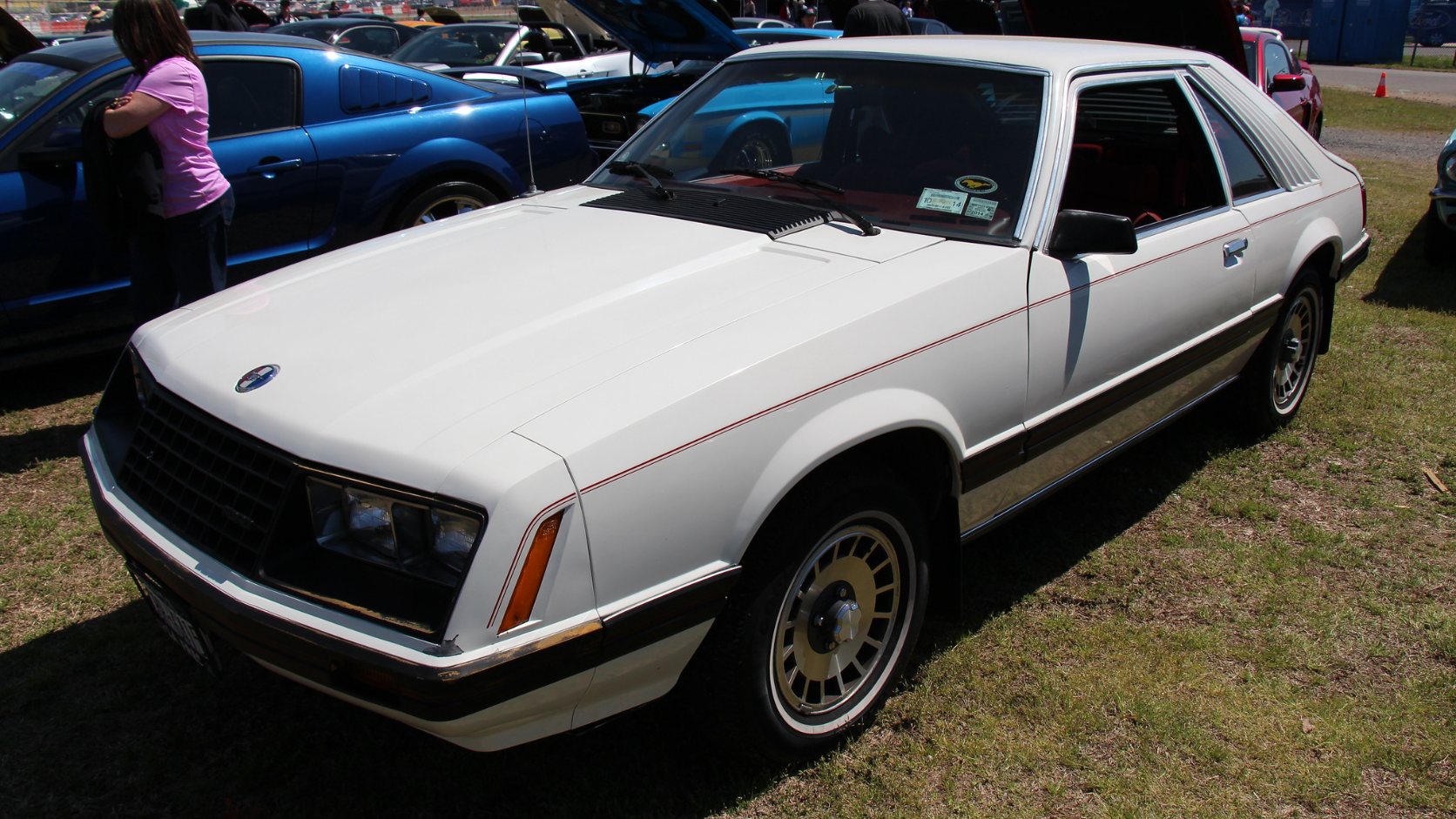
1980 Ford Mustang Ghia hatchback. Photo: Sicnag via Flickr, CC BY 2.0.
Overview
The 1980 Ford Mustang was the second year of the Fox-body generation, and it reflected the pressures of the second oil crisis. Compared with the 1979 Ford Mustang, the look barely changed, but the engine lineup did: Ford dropped the 302 V8 and replaced it with a smaller 4.2-liter (255-cubic-inch) V8 aimed at better fuel economy.
The smaller V8 produced roughly 117 to 119 horsepower and was offered only with a three-speed automatic. That left the turbocharged 2.3-liter four-cylinder, rated at about 131 to 135 horsepower, as the most powerful engine in the range. The base 2.3-liter four and the 3.3-liter inline six rounded out the choices.
Buyers could still pick a two-door notchback coupe or a three-door hatchback in base or Ghia trim. The Cobra package continued on the hatchback and now wore a front end styled after the 1979 Indy 500 Pace Car, and a five-speed manual became available late in the year for four-cylinder cars.
Ford built 271,322 Mustangs for 1980, down from the strong launch year but still a solid result. Today the 1980 car is notable as one of the few Mustangs of its era without a 5.0-liter V8, which makes clean Cobra and Ghia examples interesting to Fox-body fans. For more background, see the third-generation Mustang history, or compare it with the classic 1967 Ford Mustang.
1980 Mustang timeline
- 1978Earlier development
- 1979Previous model year
- 1980Featured model year
- 1981Continued evolution
Engine options
| Engine | Type | Horsepower | Torque | Fuel / induction | Notes |
|---|---|---|---|---|---|
| 2.3L (140 cu in) Lima | Inline-4 | Approx. 88 hp | 2-barrel carburetor | Standard engine | |
| 2.3L (140 cu in) Lima Turbo | Turbocharged inline-4 | Approx. 131–135 hp | 2-barrel carburetor, turbocharged | Most powerful 1980 engine | |
| 3.3L (200 cu in) | Inline-6 | Approx. 89–91 hp | 1-barrel carburetor | Optional six-cylinder | |
| 4.2L (255 cu in) Windsor | V8 | Approx. 117–119 hp | 2-barrel carburetor | Replaced the 302 V8; automatic only |
Specifications at a glance
Production
- Coupe128,893 (47.5%)
- Hatchback98,497 (36.3%)
- Ghia Coupe23,647 (8.7%)
- Ghia Hatchback20,285 (7.5%)
Dimensions
Original colors
Color research in progress.
Performance
Buyer’s guide highlights
- Inspect the floor pans, torque boxes, strut towers and rear frame rails for rust.
- Check doors, rocker panels, rear wheel openings and the hatch area for corrosion and water leaks.
- Confirm the engine with the VIN code — 1980 V8 cars have the 4.2-liter V8, not the 302.
- On turbo cars, check for oil smoke, leaks and weak boost, since the early turbo system was troublesome.
- Verify Cobra and Ghia trim, which can be difficult to replace if missing.
- Buy on condition and originality rather than planned upgrades.
1. Check for Rust First
A 1980 Ford Mustang is a simple car, but rust is the biggest concern. Inspect the floor pans, torque boxes, strut towers, rear frame rails and cowl area, and look for patches or heavy undercoating.
2. Look at the Body and Seals
Check the doors, rocker panels, rear wheel openings and hatch or trunk area. Worn seals can let water into the car, so check under the carpets and in the spare-tire well.
3. Identify the Engine
The 302 V8 was not offered in 1980. V8 cars use the 4.2-liter V8 with an automatic transmission. Confirm the engine code in the VIN, and be aware that many cars have since been converted to 5.0-liter engines.
4. Be Careful With Turbo Cars
The 2.3-liter turbo was the performance choice, but it had a reputation for problems. Check for smoke, oil leaks, poor boost and signs of overheating, and ask for maintenance records.
5. Inspect Suspension and Brakes
Look for worn bushings, tired springs and shocks, and leaking steering racks. A test drive should reveal clunks or loose steering.
6. Buy the Best Example You Can
Early Fox-body cars are affordable, so a solid, original car is usually worth more in the long run than a cheap project.
Values
1980 Ford Mustang values are generally modest, with clean Cobra hatchbacks and well-kept original cars attracting the most collector interest.
Market references are research guides, not appraisals. Actual value depends on condition, originality, documentation, drivetrain, options, location and current buyer demand.