1981 Ford Mustang
The 1981 Ford Mustang added a five-speed manual, T-tops and Traction-Lok, while the 4.2-liter V8 remained the top engine.
 1 / 6
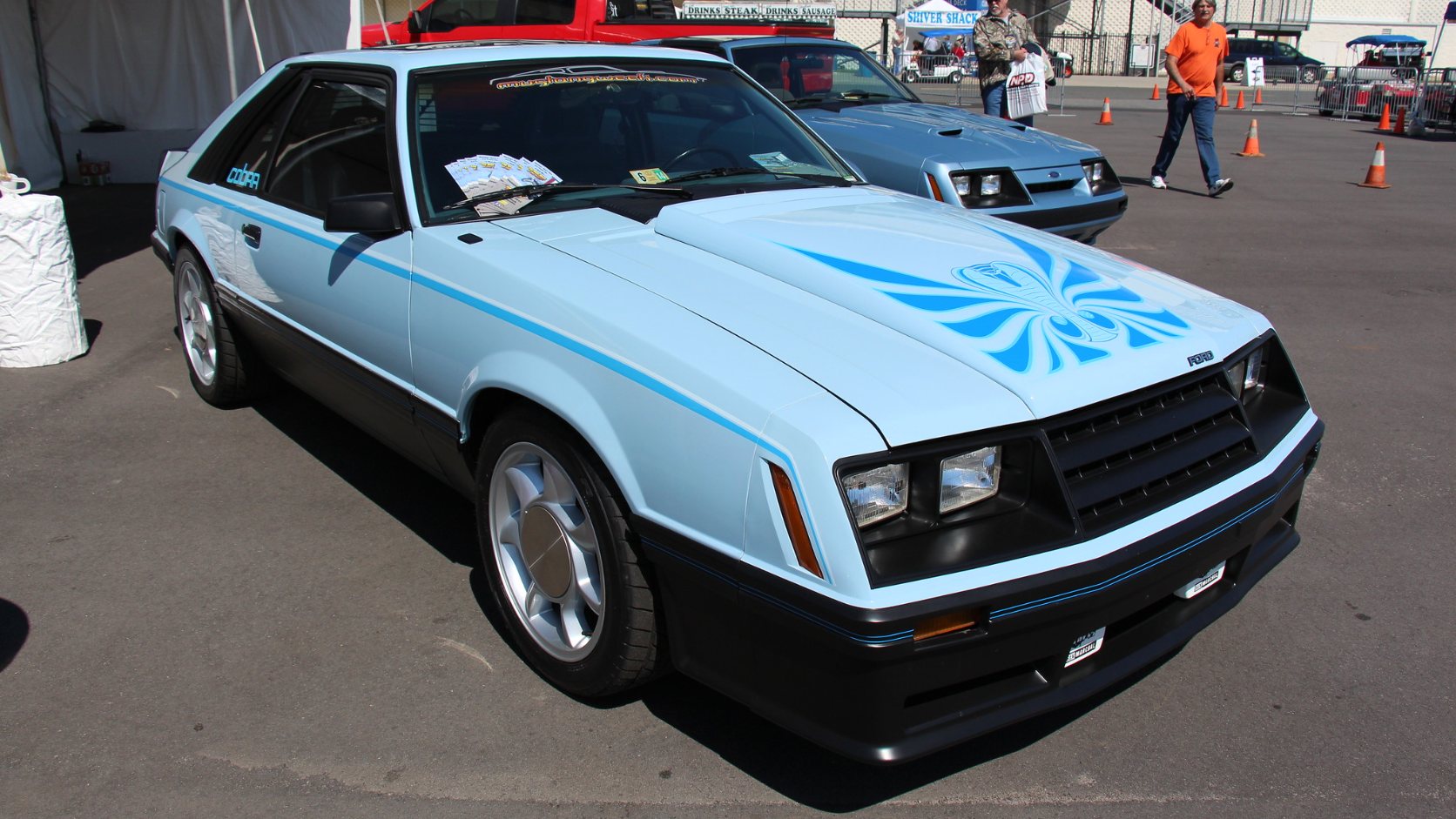
1981 Ford Mustang Cobra hatchback. Photo: Sicnag via Flickr, CC BY 2.0.
Overview
The 1981 Ford Mustang was a quiet year for the Fox-body car, with Ford focusing on small refinements rather than big changes. Following the 1980 Ford Mustang, it kept the same notchback coupe and three-door hatchback body styles, again offered in base and Ghia trim, with the Cobra package still available on the hatchback.
The most important mechanical change was a new five-speed manual transmission with an overdrive top gear, which replaced the older four-speed manual. Ford also added an optional Traction-Lok limited-slip differential that could be ordered with any engine, and a T-top roof with removable glass panels joined the options list.
Engine choices were limited. The 2.3-liter four-cylinder was standard, the 3.3-liter inline six was optional, and the 4.2-liter (255-cubic-inch) V8 remained the top engine at about 115 to 120 horsepower. The troubled turbocharged four-cylinder was no longer offered to U.S. buyers, leaving the 1981 Mustang with modest performance.
Production fell to 182,552 cars, reflecting a difficult economy and the car’s lack of excitement. Even so, the 1981 model laid the groundwork for the much stronger 5.0-liter GT that arrived the following year. For more background, see the third-generation Mustang history, or look back at the first Fox-body year, the 1979 Ford Mustang.
1981 Mustang timeline
- 1979Earlier development
- 1980Previous model year
- 1981Featured model year
- 1982Continued evolution
Engine options
| Engine | Type | Horsepower | Torque | Fuel / induction | Notes |
|---|---|---|---|---|---|
| 2.3L (140 cu in) Lima | Inline-4 | Approx. 88 hp | 2-barrel carburetor | Standard engine | |
| 3.3L (200 cu in) | Inline-6 | Approx. 88–94 hp | 1-barrel carburetor | Optional six-cylinder | |
| 4.2L (255 cu in) Windsor | V8 | Approx. 115–120 hp | 2-barrel carburetor | Top engine for 1981 |
Specifications at a glance
Production
- Coupe77,458 (42.4%)
- Hatchback77,399 (42.4%)
- Ghia Coupe13,422 (7.4%)
- Ghia Hatchback14,273 (7.8%)
Dimensions
Original colors
Color research in progress.
Performance
Buyer’s guide highlights
- Inspect the floor pans, torque boxes, strut towers and rear frame rails for rust.
- On T-top cars, check seals, drains, headliner and floors for water leaks.
- Confirm the engine with the VIN code — V8 cars should have the 4.2-liter V8, not a later 5.0 swap.
- Check the five-speed manual for grinding or popping out of gear.
- Verify Cobra trim and graphics, which are often faded, missing or reproduction.
- Buy on condition and originality, since early Fox-body trim parts can be hard to find.
1. Start With Rust
Rust is the main enemy of a 1981 Ford Mustang. Check the floor pans, torque boxes, strut towers, rear frame rails and cowl, and look for patches or heavy undercoating.
2. Check T-Tops and Weatherstrip
The T-top roof was new for 1981. Inspect the seals and drain channels, and look for water stains on the headliner and rust under the carpets.
3. Confirm the Drivetrain
Check the engine code in the VIN. Many cars have been fitted with later 5.0-liter engines, which can be fun but reduce originality. Test the five-speed manual for smooth shifts, and check for a working Traction-Lok if the car is said to have one.
4. Inspect Suspension, Steering and Brakes
Worn bushings, springs, shocks and steering racks are common. A test drive should reveal clunks, wandering or weak brakes.
5. Look at Trim and Interior
Cobra graphics, Ghia trim and interior parts can be hard to replace. Check that they are present and in good condition.
6. Buy the Best Example You Can
Early Fox-body Mustangs are affordable, so a clean original car is usually a better buy than a cheap project.
Values
1981 Ford Mustang values are generally modest, with original Cobra hatchbacks and T-top cars drawing the most interest.
Market references are research guides, not appraisals. Actual value depends on condition, originality, documentation, drivetrain, options, location and current buyer demand.