1983 Ford Mustang
The 1983 Ford Mustang brought back the convertible, restyled the nose and raised the 5.0 H.O. V8 to about 175 horsepower.
 1 / 6
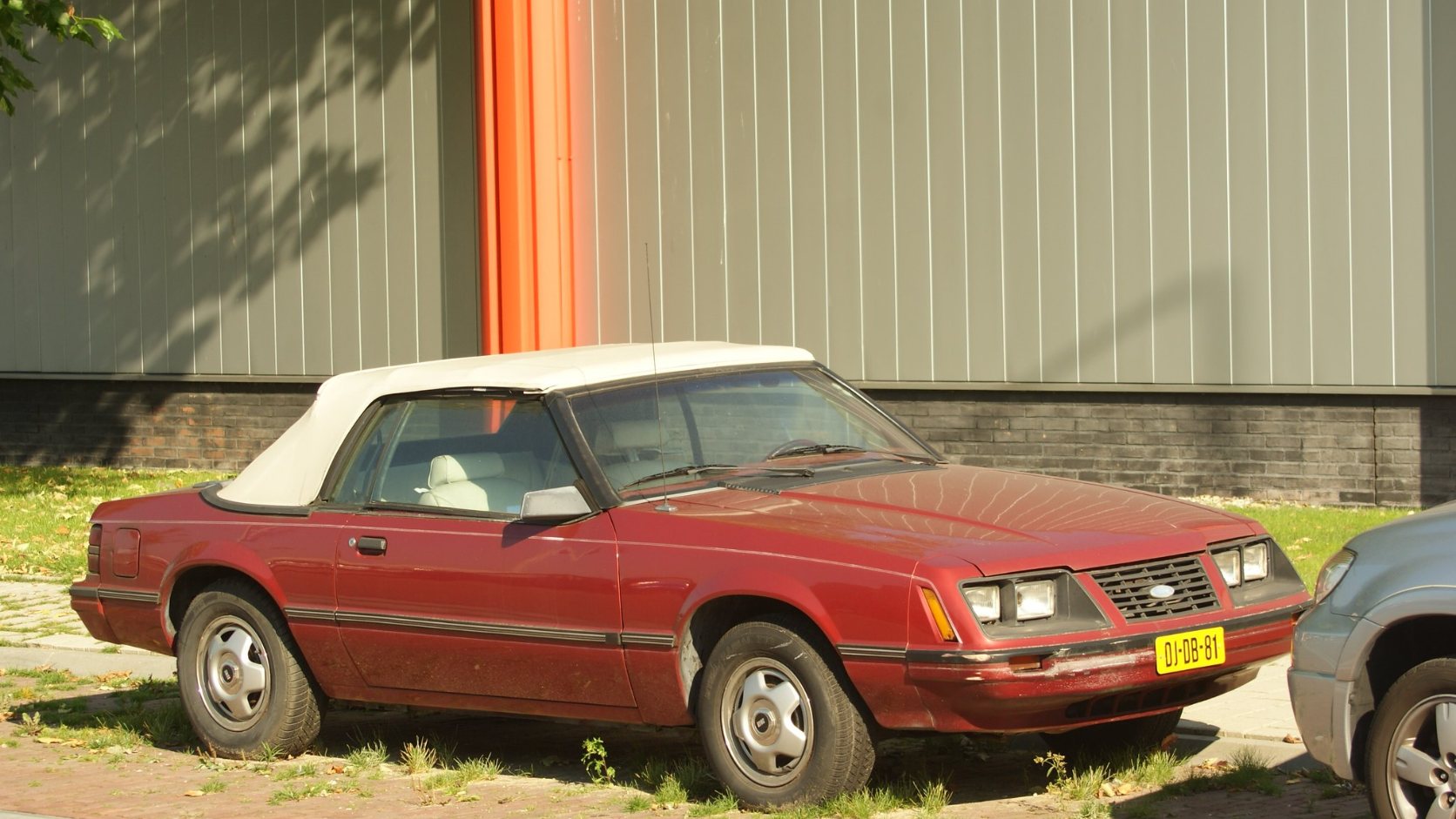
1983 Ford Mustang convertible, the first Mustang convertible since 1973. Photo: NielsdeWit via Flickr, CC BY 2.0.
Overview
The 1983 Ford Mustang brought two big changes to the Fox-body line: a fresh face and the return of the convertible. Building on the 1982 Ford Mustang, Ford gave the car a longer, more rounded nose and redesigned taillights, and it became the first Mustang to wear Ford’s blue oval emblem on the front.
The convertible was the headline news. It was the first factory Mustang convertible since 1973, and Ford built 23,438 of them for 1983. Most were equipped with the new 3.8-liter Essex V6, which replaced the old inline six, although the convertible could also be ordered with V8 power.
Performance also improved. The 5.0-liter High Output V8 gained a four-barrel carburetor and was rated at about 175 horsepower, and a Borg-Warner T-5 five-speed manual soon became available. The turbocharged 2.3-liter four also returned during the year in fuel-injected form, rated at around 145 horsepower, while the standard 2.3-liter four remained for economy buyers.
Total production was 120,873 cars. The combination of a new look, a convertible and a stronger 5.0 V8 helped make the 1983 Mustang an important step in the Fox-body story. For more background, see the third-generation Mustang history, or compare it with the classic 1967 Ford Mustang.
1983 Mustang timeline
- 1981Earlier development
- 1982Previous model year
- 1983Featured model year
- 1984Continued evolution
Engine options
| Engine | Type | Horsepower | Torque | Fuel / induction | Notes |
|---|---|---|---|---|---|
| 2.3L (140 cu in) Lima | Inline-4 | Approx. 88 hp | 1-barrel carburetor | Standard engine | |
| 2.3L (140 cu in) Lima Turbo | Turbocharged inline-4 | Approx. 145 hp | Fuel injection, turbocharged | Returned during the 1983 model year | |
| 3.8L (232 cu in) Essex | V6 | Approx. 105–112 hp | 2-barrel carburetor | New V6; common in convertibles | |
| 5.0L (302 cu in) H.O. | V8 | Approx. 175 hp | 4-barrel carburetor | GT and performance engine |
Specifications at a glance
Production
- Coupe33,201 (27.5%)
- Hatchback64,234 (53.1%)
- Convertible23,438 (19.4%)
Dimensions
Original colors
Color research in progress.
Performance
Buyer’s guide highlights
- Inspect the floor pans, torque boxes, strut towers and rear frame rails for rust.
- On convertibles, check the top, frame, seals and floors for leaks and rust.
- Confirm the engine with the VIN code — most convertibles had the 3.8-liter V6.
- Verify a claimed GT or 5.0 car, since many base cars have been converted.
- Check the manual transmission and clutch, and look for worn suspension parts.
- Buy on condition and originality, since first-year 1983 trim parts can be hard to replace.
1. Start With Rust and Structure
Check the floor pans, torque boxes, strut towers, rear frame rails and cowl area on any 1983 Ford Mustang. Convertibles are more flexible than coupes, so look for cracks or signs of structural fatigue.
2. Inspect Convertible Tops
The convertible returned for 1983 and is a desirable model. Check the top fabric, rear window, frame, motor and seals, and look for water damage in the floors and trunk.
3. Confirm the Engine
Most 1983 convertibles came with the 3.8-liter V6, while GTs used the 5.0 H.O. V8. Check the VIN engine code, and be careful with cars that have had later engines swapped in.
4. Check the Drivetrain
Test the four-speed or five-speed manual for smooth shifts, check the clutch, and listen for rear axle noise. Turbo cars should be checked for smoke, leaks and poor boost.
5. Inspect Suspension and Brakes
Worn bushings, springs, shocks and steering components are common. A test drive should show whether the car tracks straight and stops well.
6. Buy the Best Example You Can
Original, well-documented 1983 GTs and convertibles are the best long-term buys.
Values
1983 Ford Mustang values are strongest for original 5.0 GT hatchbacks and well-kept convertibles, while base coupes remain affordable.
Market references are research guides, not appraisals. Actual value depends on condition, originality, documentation, drivetrain, options, location and current buyer demand.