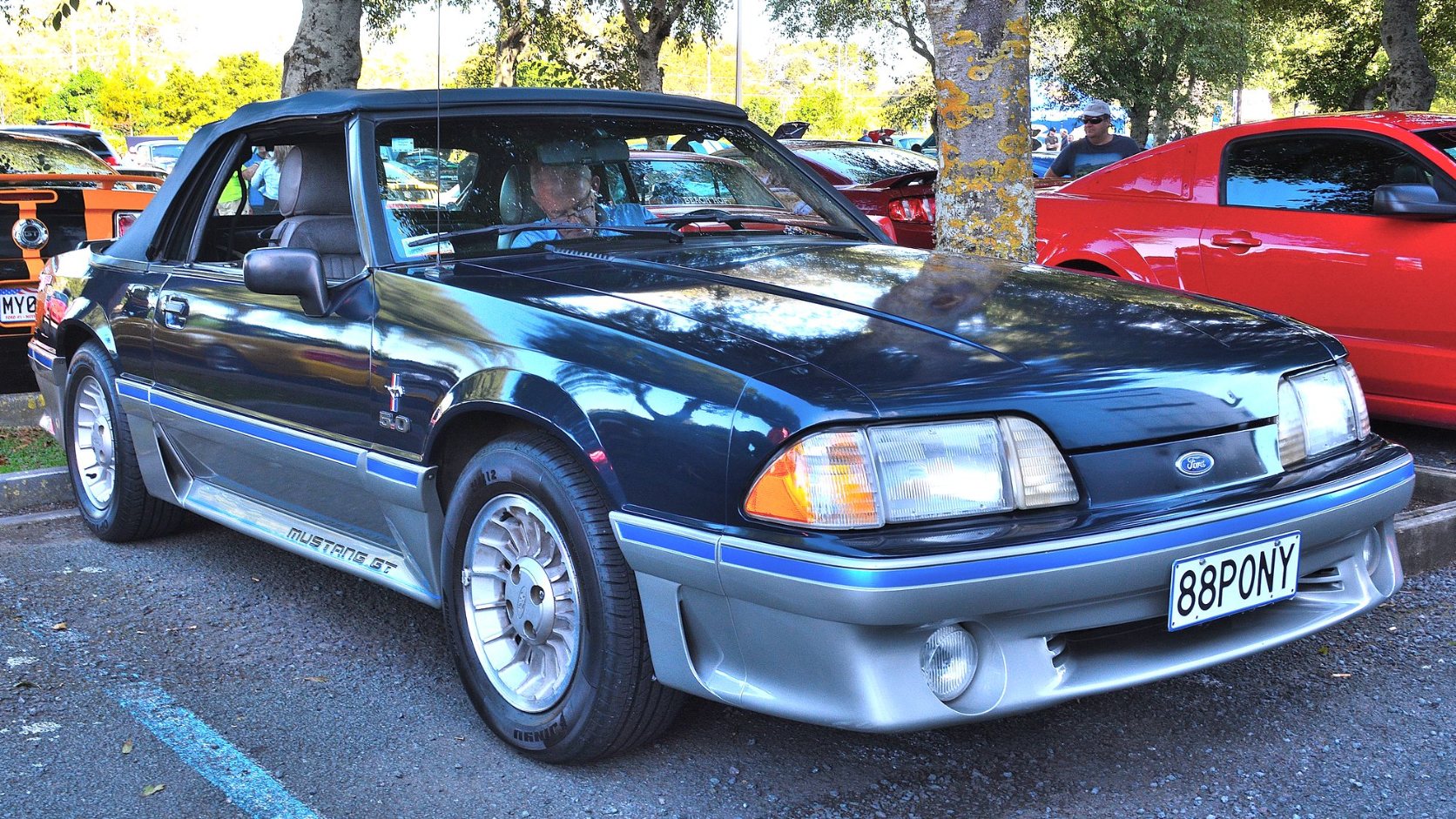
1988 Ford Mustang
The 1988 Ford Mustang continued the Aero-styled LX and GT with the 225 hp 5.0 H.O. V8, while the T-top option ended mid-year.
 1 / 6
1988 Ford Mustang GT. Photo: GPS 56 via Flickr, CC BY 2.0.
Overview
The 1988 Ford Mustang carried over the successful formula introduced with the 1987 Ford Mustang. With the Aero styling and redesigned interior already in place, Ford made few changes, and the lineup again consisted of the LX and GT in notchback coupe, hatchback and convertible form.
The fuel-injected 5.0-liter High Output V8 continued at about 225 horsepower and 300 lb-ft of torque, available in both the GT and the LX. The lighter LX 5.0 notchback in particular became a favorite with drag racers and police agencies, thanks to its strong engine and relatively low weight. The fuel-injected 2.3-liter four-cylinder remained the economy choice.
One notable change came mid-year, when the T-top roof option for hatchbacks was discontinued. Otherwise, 1988 was a year of steady refinement. Buyers could still choose between a five-speed manual and a four-speed automatic with overdrive.
Demand was strong, with Ford building 179,565 Mustangs for 1988, including 33,344 convertibles. The 1988 cars share their styling and powertrain with the most popular Fox-body years, making them an attractive choice for enthusiasts today. For more background, see the third-generation Mustang history, or compare it with the classic 1969 Ford Mustang.
1988 Mustang timeline
- 1986Earlier development
- 1987Previous model year
- 1988Featured model year
- 1989Continued evolution
Engine options
| Engine | Type | Horsepower | Torque | Fuel / induction | Notes |
|---|---|---|---|---|---|
| 2.3L (140 cu in) Lima | Inline-4 | Approx. 90 hp | Fuel injection | Base engine | |
| 5.0L (302 cu in) H.O. | V8 | Approx. 225 hp | Approx. 300 lb-ft | Sequential multiport fuel injection | GT and LX 5.0 engine |
Specifications at a glance
Production
- Notchback71,890 (40.0%)
- Hatchback74,331 (41.4%)
- Convertible33,344 (18.6%)
Dimensions
Original colors
Color research in progress.
Performance
Buyer’s guide highlights
- Inspect the floor pans, torque boxes, strut towers and rear frame rails for rust and accident damage.
- Confirm an LX 5.0 or GT with the VIN engine code and paperwork.
- Check T-top cars, built only early in the year, for leaks and rust.
- Look for heavy modifications, which are common on 5.0 cars.
- Test the manual transmission, clutch and rear axle for wear.
- Buy on condition and originality, since stock cars are becoming rare.
1. Start With Rust and Structure
Check the floor pans, torque boxes, strut towers and rear frame rails on any 1988 Ford Mustang, and look for accident repair.
2. Confirm the Model and Engine
Check the VIN engine code to confirm a genuine 5.0 car. LX 5.0 notchbacks are especially desirable and often copied.
3. Check for Modifications
Many 5.0 Mustangs have been modified. Original cars bring more money, so look for aftermarket parts and ask for the car's history.
4. Inspect the Drivetrain
Test the five-speed manual and clutch, check automatics for smooth shifts, and listen for rear axle noise.
5. Buy the Best Example You Can
A clean, documented car will usually hold its value better than a modified or neglected one.
Values
1988 Ford Mustang values are strongest for original GT and LX 5.0 cars, especially low-mileage notchbacks and convertibles.
Market references are research guides, not appraisals. Actual value depends on condition, originality, documentation, drivetrain, options, location and current buyer demand.