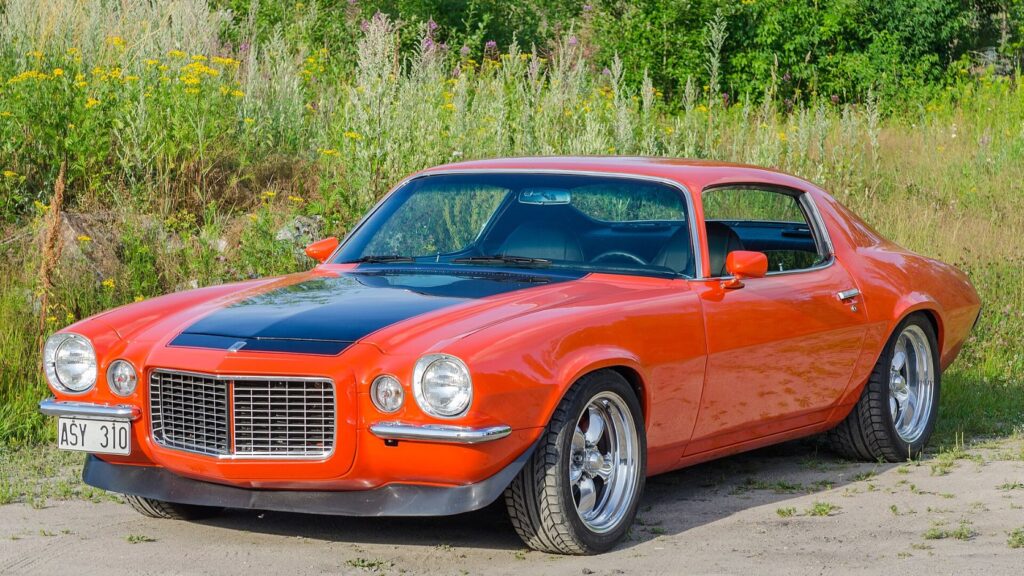
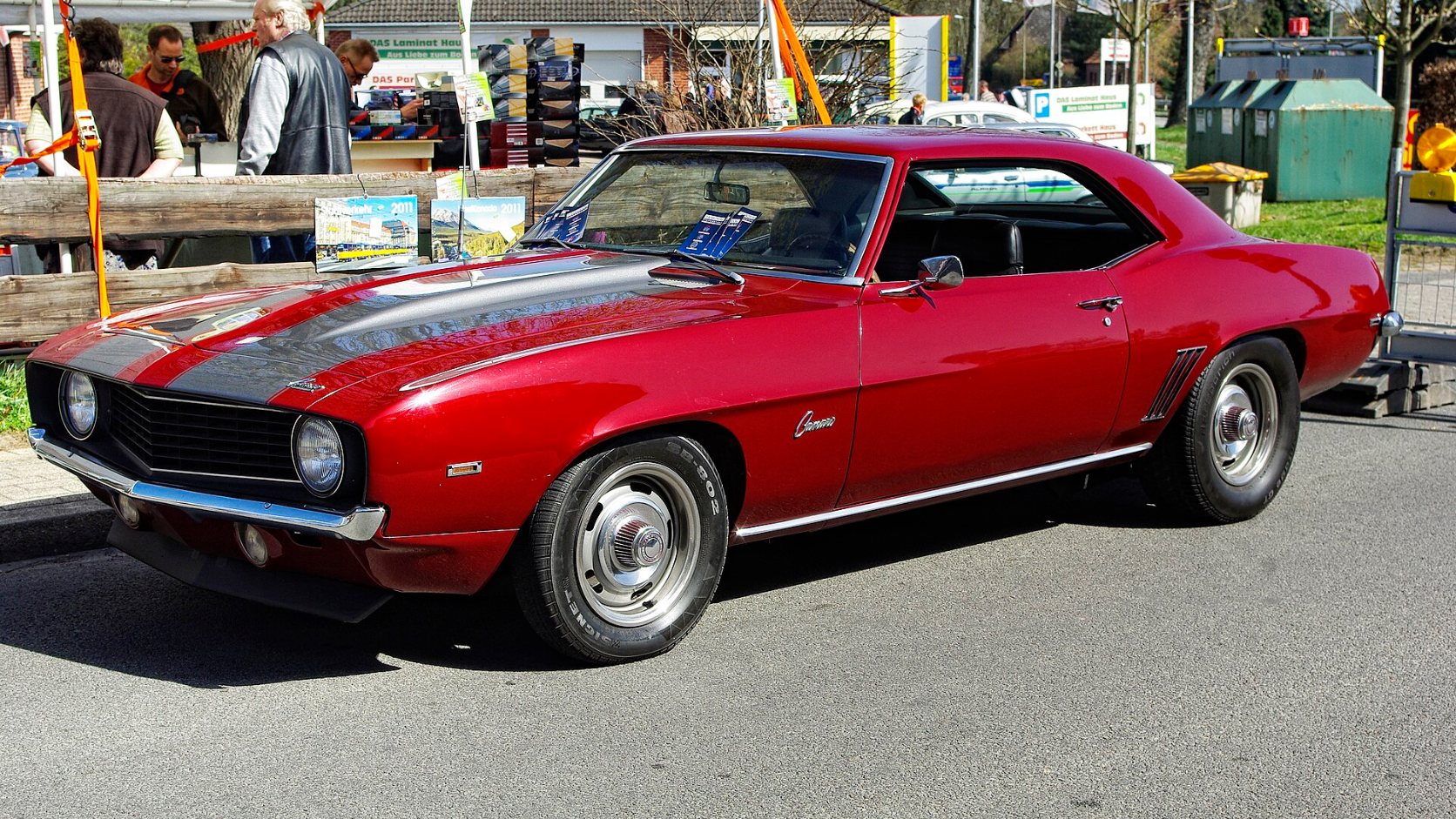
1969 Chevrolet Camaro
The 1969 Chevrolet Camaro closed the first generation with new styling, the Z/28 and the rare COPO 427 cars.
 1 / 6
1969 Chevrolet Camaro. Photo: OlliFoolish via Wikimedia Commons, CC BY-SA 3.0.
Overview
The 1969 Chevrolet Camaro was the last year of the first generation and is the most recognized Camaro of all. It followed the 1968 Chevrolet Camaro with the same roof, hood and trunk lid, but nearly every other body panel was new.
The new sheetmetal gave the car a lower, wider and more aggressive look, with creased fenders, squared wheel openings and a deep V-shaped grille. The Rally Sport package again added hidden headlights, now behind slatted doors, and the SS and Z/28 packages continued. A white and orange Camaro RS/SS convertible paced the Indianapolis 500 for the second time.
The engine list was the widest yet, from the base six through small-block and 396 V8s to the 302 in the Z/28. Through the Central Office Production Order system, dealers such as Yenko could also order 427 big-blocks that were not on the regular option sheet. The rarest was the all-aluminum ZL1, with just 69 built.
Because the second-generation car was delayed, the 1969 model year ran long and production reached 243,085, including 20,302 Z/28s. Like the 1969 Ford Mustang, it marks a high point of the original pony car era.
1969 Camaro timeline
- 1967Earlier development
- 1968Previous model year
- 1969Featured model year
- 1970Continued evolution
Engine options
| Engine | Type | Horsepower | Torque | Fuel / induction | Notes |
|---|---|---|---|---|---|
| 230 Turbo-Thrift | I6 | 140 hp | 220 lb-ft | 1-barrel carburetor | Base engine |
| 250 Turbo-Thrift | I6 | 155 hp | 235 lb-ft | 1-barrel carburetor | Optional six |
| 307 / 327 Turbo-Fire | V8 | 200–210 hp | 2-barrel carburetor | Base V8; 307 replaced the 327 during the year | |
| 350 Turbo-Fire | V8 | 250–255 hp | 2- or 4-barrel carburetor | Optional | |
| 350 Turbo-Fire (L48) | V8 | 300 hp | 380 lb-ft | 4-barrel carburetor | SS 350 |
| 396 Turbo-Jet | V8 | 325–375 hp | Up to 415 lb-ft | 4-barrel carburetor | SS 396, three versions |
| 302 (Z/28) | V8 | 290 hp (advertised) | 290 lb-ft | 4-barrel Holley carburetor | 20,302 Z/28s built |
| 427 (L72, COPO) | V8 | 425 hp | 460 lb-ft | 4-barrel Holley carburetor | Special order |
| 427 (ZL1, COPO) | V8 | 430 hp (advertised) | 4-barrel Holley carburetor | Aluminum block, 69 built |
Specifications at a glance
Production
243,0851969 Chevrolet Camaro
Dimensions
Original colors
Color research in progress.
Performance
Buyer’s guide highlights
- Check the rear quarters, trunk floor, floor pans, cowl and subframe mounts for rust.
- Use the trim tag: many 1969 cars carry X-codes that help identify SS and Z/28 models.
- Verify matching engine and transmission stampings on high-value cars.
- Treat any claimed COPO, Yenko or ZL1 with great care and insist on expert documentation.
- Check RS headlight doors, which are vacuum operated.
- Buy on documentation and originality; clones and tribute cars are very common.
1. Check for Rust
Inspect any 1969 Chevrolet Camaro for rust in the rear quarter panels, trunk floor, floor pans, lower fenders, cowl and around the front and rear glass.
2. Authenticate the Model
The 1969 is the most cloned Camaro. Trim tag codes, engine and axle stampings and original paperwork should all agree before you pay for an SS, Z/28 or pace car.
3. Be Careful with COPO Cars
Genuine COPO 427, Yenko and ZL1 Camaros are extremely valuable and often imitated. Independent expert verification is essential.
4. Inspect the Subframe and Suspension
Check the bolt-on front subframe and mounts for rust or accident damage, and look at rear springs, shocks and bushings.
5. Buy the Best Example You Can
Every part is reproduced, so many cars have been heavily rebuilt. A solid, honestly described car with history is the safest purchase.
Values
1969 Chevrolet Camaro values are led by ZL1 and COPO 427 cars, followed by documented Z/28s, SS 396s and pace car convertibles; base six-cylinder and small-block coupes are the most affordable.
Market references are research guides, not appraisals. Actual value depends on condition, originality, documentation, drivetrain, options, location and current buyer demand.